
School Committee, Teachers' Union Clash Over Early Release Days
Burlington's School Committee voted down a teacher union proposal to extend elementary early release days, sparking frustration ahead of contract talks.

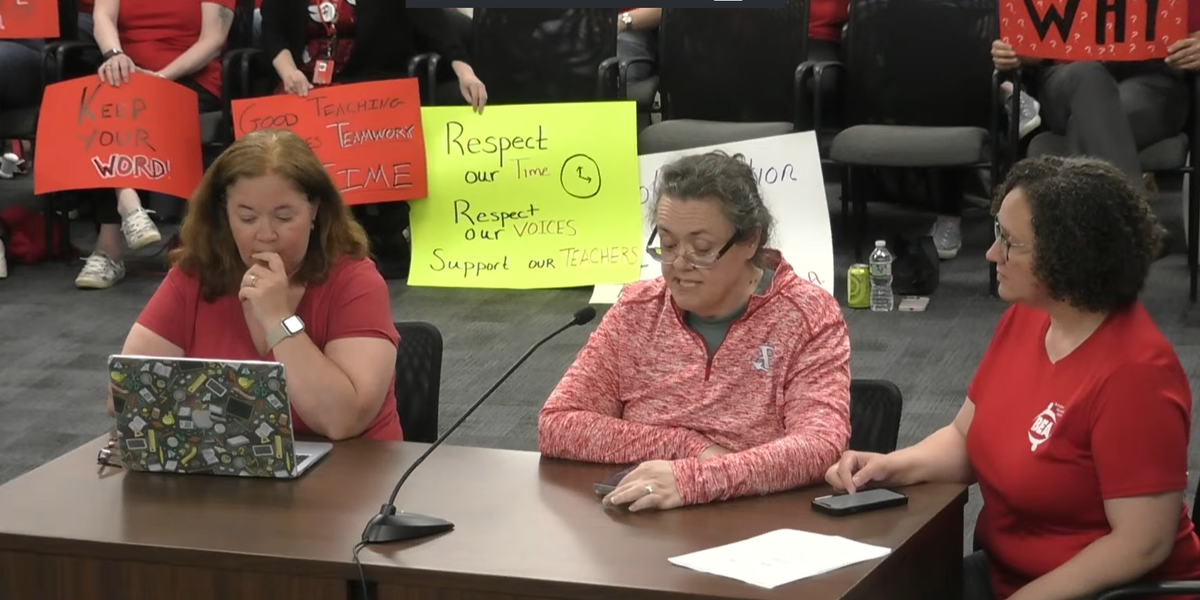
A vote taken behind closed doors on May 12 is playing out in a very public way as members of the Burlington Educators Association (BEA) express disappointment and concern over the School Committee's rejection of a proposed calendar that would have extended this year's early release pilot for another year.
Early Release Days: Long-Requested, Short-Lived
Early release days have long been a topic of interest in the School Committee room, as the BEA – the district's teacher's union – has asked the School Committee to add them into the schedule for years, said School Committee Chair Katherine Bond. In 2025 the Committee agreed to a Memorandum of Agreement (MOA, essentially a temporary agreement on top of the official teacher's contract) that allowed for eight early release days, essentially one per month, at the elementary level.
These early release days, teachers said at the School Committee's May 26 meeting, allowed for collaboration and professional development among teachers that hasn't always been possible – work that was particularly important in light of the district's adoption of the new CKLA literacy curriculum for grades K-5.
Third grade teacher at Memorial Elementary School, Crystal Muise-Keating, said the time spent learning the new curriculum went well beyond the 28 early-release hours set aside by the School Committee. "We have been trying to learn the curriculum while we teach it, which is never ideal for teachers or students," she said, and added that the implementation team has plans to continue refining implementation this year while also working on other curriculum adjustments.
Literacy and general education teachers benefitted from time to learn in community about the curriculum and how to implement it but, said Pine Glen music teacher Jen Agati, teachers of "specials" like music, P.E., and art also had the opportunity to collaborate in a way they hadn't before.
"It was a huge value add to our school year to be able to meet as a group once a month," said Agati, sitting in front of a backdrop of posters with messages such as Respect Our Time | Respect Our Voices and simply WHY?!
She said other departments, such as English learner and guidance, had also enjoyed greater collaboration.
Nonetheless, said Bond, the early release pilot was just that – a single-year endeavor to support teachers during the first year with a new curriculum. "There shouldn't have been any surprise" that the agreement was not extended, said Bond. "It was a big concern [during last year's negotiations] that the early release days were going to take teaching time away from the students." Indeed, reading from a prepared statement at the May 26 School Committee meeting, Bond cited teacher face time as the primary reason for rejecting the proposed extension.
"We Never Have Enough Time:" The Tension Between Student and Teacher Learning Needs
While details of the executive session aren't yet public, School Committee member Meghan Nawoichik, who sits on the negotiations subcommittee, said she and fellow member Christine Monaco had a productive conversation with union representatives and Superintendent Dr. Eric Conti about the pros and cons of the early release schedule. The balance between teacher and student needs, she said, has proven hard to strike. "I don't think there's a perfect answer to this," said Nawoichik, "and I don't think there was complete consensus that this early release schedule was the best solution."
Superintendent Eric Conti, who is employed by the School Committee but works with educators in the district, said his role is to be sure students don't get lost in these conversations. "We never have enough time," said Conti, and there's simply tension between two legitimate needs: the need for students to be in classrooms with teachers, and the need for teachers to have sufficient time for professional development and collaboration.
Conti said the School Committee had a "carefully considered" discussion about the topic. "Everyone is trying to do what's right," he said.
School Committee member Melissa Massardo, speaking at the May 26 meeting, expressed her dissent with the vote. "I have heard directly from teachers that this time was vital to their learning and positively impacted their classrooms," she said, "I'm disappointed that this whole board could not agree to something that our educators have clearly demonstrated they needed for our students."
In a statement to Burlington Buzz, Massardo added, "When both the teachers and the leader of curriculum and learning tell you that they need the time, you listen. These refreshed curriculums are long overdue and by making it more difficult for teachers to get trained on their delivery, we set back our students. Now to complete the training, teachers will get pulled regularly from classrooms. It will take us much longer to standardize math instruction at the elementary level and realize the value of our investment in the new curriculum. As a parent of an incoming 5th grader, this makes me furious."
BEA President Sean Musselman echoed this disappointment on social media, in interviews, and during public participation time at the May 26 meeting. The union and the School Committee had a single collective bargaining session this year, said Musselman, and the School Committee seemed amenable to the updated MOA submitted by the union. He and other union members were surprised, he said, when the document, which asked for 7 release days in 2026-27 (down from 8, conceding for an early release on Good Friday), was voted down.
Musselman said the MOA was approved by a majority of elementary voting members and included trading off some of their autonomy during planning time. The decision, Musselman said in his statement, is "deeply paternalistic... It feels to our educators like nothing more than a patronizing pat on the back to the entire district saying don't worry children, we know what's best."
A Private Vote, Made Public
Perhaps more surprising than the clash between the School Committee and the union is the fact that the vote, taken in executive session, made it to the public awareness less than 12 hours after it happened. Executive session is a protected, closed-door session with separate minutes, entered into because the Committee needs to discuss confidential matters that may impact their collective bargaining position. While the source of the leak wasn't publicly identified, Nawoichik expressed disappointment at the unilateral release of this information.
"Once the Committee as a whole determines that releasing the information would no longer compromise the purpose of the executive session, the Committee can approve and release the minutes and share information through the proper channels. That decision is not up to any single member to make independently," said Nawoichik, who added that a similar breach occurred last year around the same topic.
The teacher's contract is in place through June 30, 2027, which means the School Committee and the BEA will be negotiating during the 2026-27 school year for their new contract. As for next year's school calendar, it's been set for months and it doesn't appear that early release days will be added in.
"I don't think we'll be going back into executive session to reconsider the early release calendar," said Bond, though she and Nawoichik both say they look forward to good-faith negotiations during the next school year that may explore different ways for teachers to have their professional development needs met while ensuring kids' opportunities to learn from their teachers are maximized.