
Burlington's Middle School Robotics Team Takes Their Case for Archaeology to Canada Cup
Burlington's Accidental Archaeologists head to Canada Cup, an international FLL invitational, after a season exploring why archaeology funding matters.

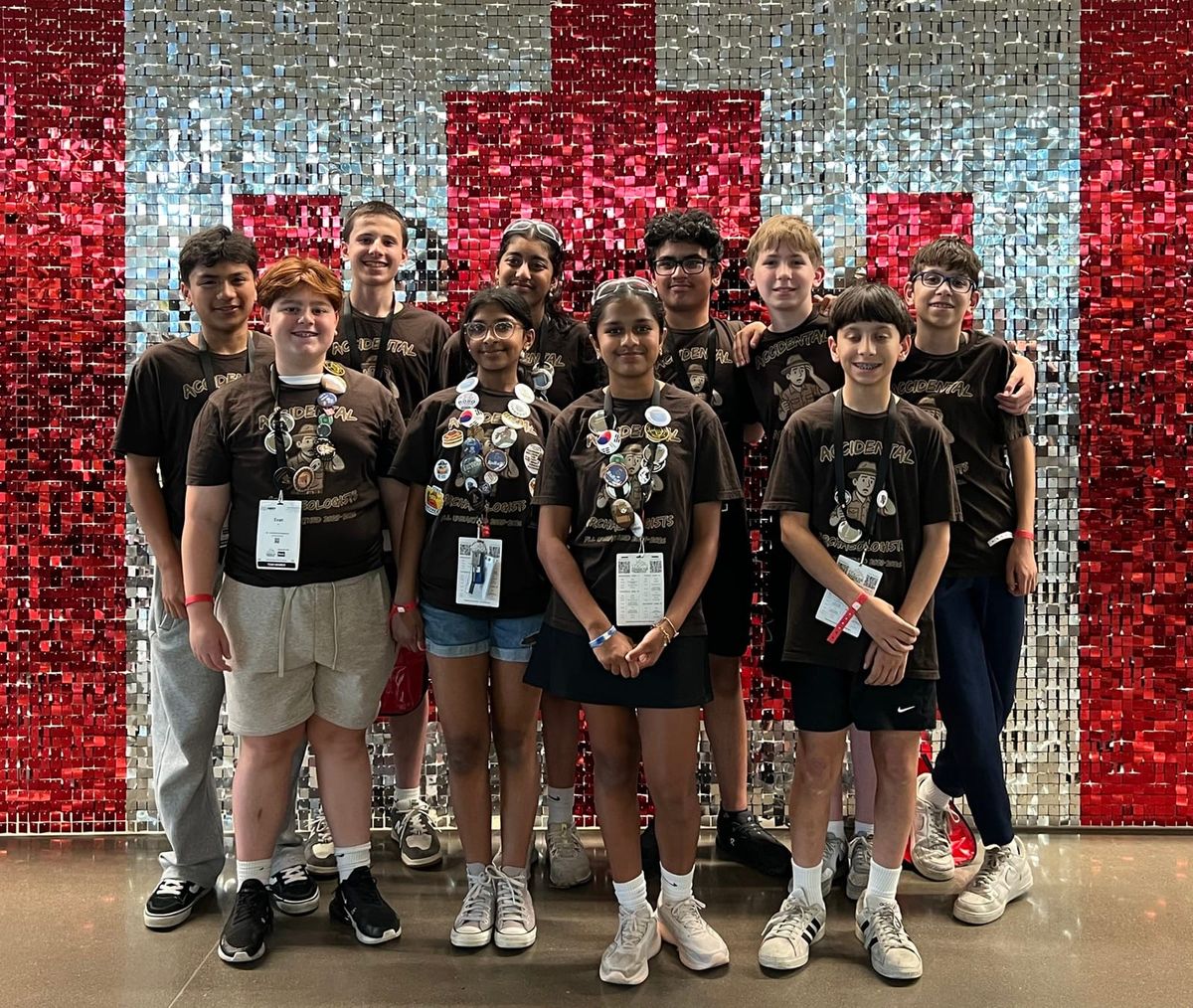
Burlington's Accidental Archaeologists, a team of 10 middle schoolers, opened their international debut this week at the Canada Cup, an invitational FIRST LEGO League (FLL) tournament near Niagara Falls drawing 97 teams from 23 countries. After two practice runs, the team ran its first official match. "It was pretty good — not a bad first start," said coach Heather Peckham, who added the team is looking to improve in the matches still ahead.
This season's competition theme, Unearthed, centers on the challenges of archaeology, and teams built robots to complete missions tied to uncovering and preserving artifacts. But the robot game is only part of the competition. Teams are also judged on an "innovation project" addressing a real-world problem in the spirit of the theme, and on a set of core values reflected in how they work together. Combined, those two elements make up 75 percent of a team's score; the two days of robot runs that form the more visible part of the competition account for the remaining 25 percent.
Mirroring the high school FIRST robotics league team DevilBotz, the Accidental Archaeologists designed and built their robot independently, relying on coaches Peckham and Matthew Jarvis as facilitators rather than instructors. In fact, the coaches are excluded from the 30-minute scoring session where students present their work and field judges' questions.
This year's innovation project set out to answer a question the team couldn't initially answer themselves: Why should archaeology funding be prioritized, when schools and hospitals are competing for the same public dollars? The team turned to AI research tools, repeatedly pushing past generic answers — Peckham recalled them telling it, "Don't just say 'healthcare'" — until they landed on specific, concrete links between historical discoveries and modern applications such as joint replacements inspired by ancient Roman ceramics and DNA research on ancient Tibetans to help treat heart and lung diseases.
Convinced, and equipped with a new (and apropos) team name, the Accidental Archaeologists built a board game designed to make that same case to the public, with a built-in quiz to measure whether it actually worked. It did: at a Community Game Night at the Burlington Public Library, every participant who took the quiz before and after playing improved their score. The game later found a second life in elementary classrooms at Francis Wyman and Pine Glen.
That enthusiasm led the team to standout showings at both regional and state competitions, eventually punching a ticket to their first international match. They brought home the first place award at the December qualifier at Worcester Polytechnic Institute, against a field of about 40 teams. The team then advanced to the Massachusetts Western Championship, also held at WPI, where it placed fifth out of 72 teams and was named an Innovation Project Award finalist.
The team chose the Canada Cup from a list of competitions from South Korea to Greece to Mexico, in part because it was close enough to drive and less costly for a three-day event than flying to a far-flung destination. While the team took home the first place Innovation Project award in 2023-24 and last year took the 4th Place Champions Award at states, advancing to the American Robotics Open Championship in New Jersey both years, Canada is the farthest the team has traveled in Peckham's eight years and 11 teams of coaching FLL in Burlington.
The first day of practice and competition was held on June 18, and the team will continue competing through the end of the day on June 19. Awards will be given on the morning of June 20 before teams depart. Between matches, teams decorate 10-by-10-foot pit areas and trade buttons and swag. They are also free to watch and learn from other teams, though Peckham said the schedule has left little downtime so far.
The robot itself is still evolving match by match — a piece that came loose during a practice run sent the team back to their pit to reinforce it before their first official run, and the team is continually correcting for the robot's response changing conditions such as temperature and humidity.
This habit of iteration is one the team built after December's state championship, when they decided their robot's weakest point was the handoff between missions, the moments when they swap one attachment for another mid-run. Rather than hand the fix to one or two kids, the team split into three groups to each take a crack at it, then combined all three groups' solutions into a single, faster system.
The Accidental Archaeologist FLL team pulls on a thread that runs the length of Burlington's civic life in miniature: a question raised in a middle school robotics pit found its way onto a game table at the public library, then into elementary school classrooms at Francis Wyman and Pine Glen, proving its point one improved quiz score at a time. And if the pattern Peckham has watched for eight years holds, the Accidental Archaeologists themselves are headed for the next link in that chain — the DevilBotz, high school robotics team, which just finished its own FIRST Robotics Competition season.
The Accidental Archaeologists are Aaryahi Agrawal, Connor Capparelli, Anaika Dutta, Christopher Jarvis, Nicholas Jarvis, Evan Krumlian, Gurhaan Pandey, Matthew Peckham, Rohan Prajapati and Shruti Vijayakumar, coached by Heather Peckham and Matthew Jarvis.