Spiders, Scorpions and Lizards, Oh, My!
An expedition takes us deep in the desert on the Sea of Cortez to study an ecosystem — just as a different version of the same story plays out in our own backyard.

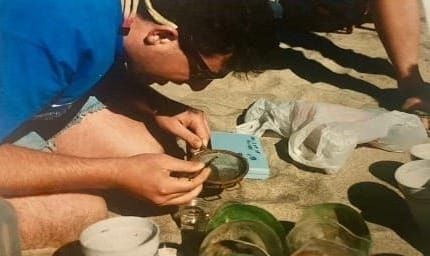
Life energy can flow from the land to the water in our familiar lakes and streams in well-known ways – leaf litter, sediment, and insects being eaten by fish are examples right in our own town. But how does energy flow the other way – from the aquatic to the terrestrial environment? That flow certainly exists here in Burlington but may not be as evident here as it is in one harsh environment where all the land-life was dependent on energy from the sea.
How exactly does the ocean support a vibrant population of animals in a thin strip of land between the desert and the sea? On an Earthwatch expedition in 1996, my wife Jane and I went to one of the deepest deserts in the Americas to help answer that question.
Our 5-vehicle caravan drove 10 hours due south from San Diego through Baja California in Mexico to a small town called Bahía de Los Ángeles, a remote isolated fishing village of a few hundred residents. Bahía is in the Sonoran Desert and, with only 2.7” of rainfall in an average year, it's almost as dry as Death Valley.
The drive down was desert, desert, desert. It looked like it hadn’t rained in a decade, just scrub brush and many giant Cardón cacti, (elephant cacti), the tallest cacti in the world. An elephant cactus can be 60 feet tall, visibly similar to but even taller and wider than the more familiar Saguaro.
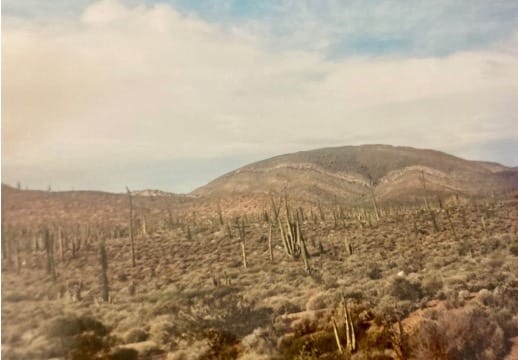
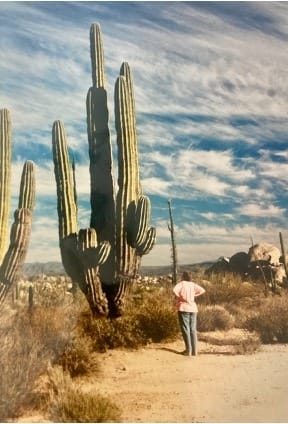
Views driving from Ensenada
We passed through two or three remote check-points where teens with machine guns came out to search our vehicles for drugs and guns. Thankfully we were not carrying either; it didn’t hurt that one member of our party was fluent in Spanish. Eventually we arrived at Bahía de Los Ángeles, where the desert comes right up to the oceanfront on the Gulf of California (also known as The Sea of Cortez). From where we stood on the shore, the contrast between the vast parched desert behind us and the open cool ocean in front was remarkable.
Our lodging consisted of an open-air building about 6 feet from the high-water mark of the shore line. There were no private rooms, but it did have curtained men’s and women's changing areas. The building was furnished with a few couches, chairs and tables.
There was no running water. The toilet had to be flushed with a bucket of sea water. The shower was from an overhead solar-heated tank of salt water, so shower times were kept to a minimum. We’d be lucky to get two or three short showers before the tank had to be refilled. It took several hours before barely-warm salt water was again available for showering. Electricity from the town generator shut off precisely at 10 pm every night.
There was a kitchen with a stove and a refrigerator/freezer. Food consisted of cereal, fruit, sandwiches and pasta dishes with some veggies for dinner. Seafood from the local fishermen was also on the menu.
We slept on large canvas cots on the beach. It was wonderful to sleep outdoors in the ocean air enjoying magnificent sunrise views over the islands in the Sea of Cortez.
Our fearless leader was Dr. Gary Polis, a professor from Vanderbilt University (and later UC-Davis), arachnologist, and the world’s leading expert on scorpions. Polis was a noted desert ecologist and had advised the US government on desert scorpions during the Gulf War.
The team consisted of Gary, twelve of us Earthwatch volunteers, and a handful of graduate students. The ultimate goal of the project was to study the flow of energy from the aquatic to the terrestrial environment both on the mainland and on the nearby islands. The research didn’t begin or end with our expedition; it was part of a project that took place over several years.
During our two weeks with the team, we documented how detritus washing up from the ocean was turned into terrestrial energy by tiny insects that ate it. Those insects supported larger insects; those supported spiders; spiders supported larger animals such as lizards and scorpions, which in turn supported even larger animals such as coyotes. The ecosystem in that narrow strip directly adjacent to the ocean was much more diverse and vibrant than that just 50 yards inland.
On the islands, the steep shoreline did not trap much detritus. It was the sea birds that brought ocean energy to the terrestrial environment here – by eating fish and leaving behind fish carcasses, bird droppings, egg shells, unhatched eggs, and dead baby birds. All that "waste" supported insects, spiders and sometimes small animals (scorpions, lizards).
There were two primary daily teams. One went by small boats out to tiny islands in the Gulf to survey and identify spiders and lizards, as well as the terrestrial plants (mainly cactus). The other group stayed on the desert shore and documented life along the desert/shore interface. The shore group also measured incoming drift of detritus (seaweed and carrion). No prior experience was needed; each group was trained on-site. Jane and I worked mainly with the island group, although Jane spent some time with the shore group. Each day, Jane and I made a point of being on separate boats, and traveling to different islands. Then, by sharing our experiences we learned more than if we’d done everything together. (Actually, that describes our whole life together!)
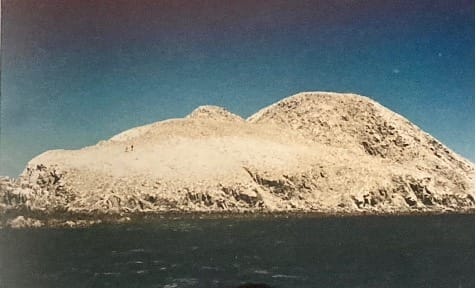
Traveling to the islands was exciting. Winds would pick up rapidly, especially in the afternoon, as the hot desert air mixed with the cool air over the water. Our small boats, borrowed from native fishermen, bounced crazily through often very choppy water; dolphins frequently surfed in our wake. We were often cold and ocean-water soaked by the time we reached the islands or returned to shore. We quickly warmed up and dried off in the desert air. That's not to minimize the brutality of the environment: One of our volunteers did get so cold that she developed severe hypothermia and had to be med-evaced out via a small private plane.
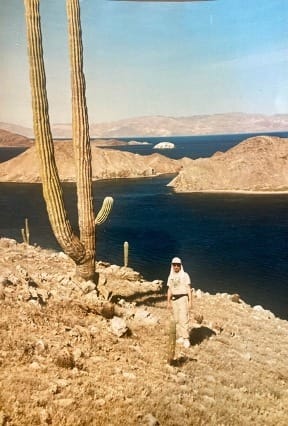
On the islands we climbed very steep terrain to reach the top, where we would measure the density of lizards, spiders, and the insects that support the spiders. Lizard density on the islands was documented by the number sighted per person-hour as we walked at a controlled pace throughout each tiny island. Spider density was determined by censusing spiders on cactus, identifying species, measuring size, and determining their prey by remains found in their webs. Sticky traps were also placed at each site to document insect prey amounts and species available to support the spiders.
With the exception of birds, each island was isolated from the others, which meant each would have a very different population of spiders, scorpions, and lizards. Some had no scorpions, some no lizards. Jane discovered a scorpion on one island whose species had never been observed on that island. The researchers were very excited about that. (So was Jane!)
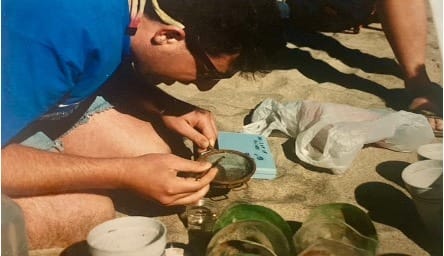
Back on shore, researchers would clear a shore area and then document the volume and type of fresh detritus that washed up over measured times. They would record any species of insects encountered. At dusk dixie cup traps were buried with their tops flush with the sand surface, allowing team members to document the tiny creatures that fell in overnight.
Other team members spent significant time examining insects under a microscope to identify them; still others entered vast amounts of data into computers. The entire process was tightly controlled, very scientific, and – for voracious learners like Jane and me – thoroughly enjoyable.
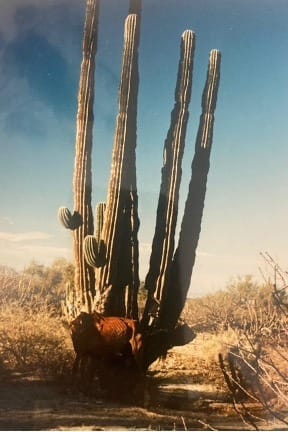
One day a small group of us decided to drive into the desert during the day just to see what it was like. It was full sun and brutally hot. No signs of life at all…no birds, no insects, no lizards…nothing. We found the mummy of a dead burro still standing, leaning against an elephant cactus, and a raven wing…no raven, just a wing that I scooped and still have. There was not a sound…no clouds, no wind. It gave clear meaning to the term “dead quiet”. The whole scene was something right out of Carlos Castaneda.
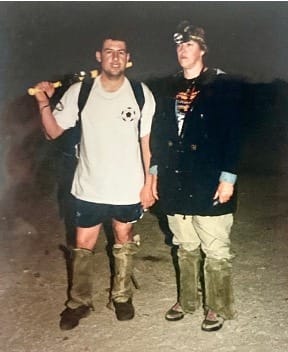
There are animals living in the desert, but they mostly come out at night to avoid the scorching heat. One night Jane and I went out with Drew, one of the graduate students, looking for scorpions. Drew wanted to collect some for study back at his college. Interesting fact: many scorpions, under black light, glow in the dark. So, Drew had a backpack-battery that powered a strong blacklight and we went hunting in the desert. Scorpions were very easy to spot in the UV light. Drew caught them and placed them in individual small jars. I did not want to touch them, but Jane stuffed thirteen jars of scorpions into her pockets! I thought she was insane doing that! If she tripped and fell, she was a goner. (Another scorpion tidbit: the smaller they are, the more deadly the sting.)
At the conclusion of the project, we headed north, stopping in Ensenada for a farewell group dinner. As we left the restaurant, we witnessed a gunfight between policia and gang members in the street. Sharp-eyed Jane observed one of the gang members run off, doff his hat and jacket, and then try to casually walk away. Jane pointed him out to the policia, and he was apprehended. At that point we decided it was probably best to get out of town!
Back home in Burlington, I find myself looking at familiar places differently. The muddy edge of the Vine Brook, the debris line along a walking trail after a heavy rain — these aren't messes to be cleaned up. They're the bottom of a food chain, the same quiet engine that powers life in the Sonoran Desert. Energy moves from water to land everywhere, not just in the most dramatic deserts on earth. You just have to know to look for it. If you want to see it up close — whether in Baja or on Cape Cod — Earthwatch (earthwatch.org) connects volunteers with exactly this kind of field research. No experience required. Jane and I have done three expeditions and recommend them highly.
Post Script:
Four years after our expedition, we were shocked and saddened to hear that Dr. Gary Polis died in a sea storm in the Sea of Cortez while continuing the very same research project as we were on. He was cited by a survivor as attempting to help others reach safety as a priority before his own. A total of 5 people died in the accident. An eyewitness account of the incident can be found here (keep scrolling through the ads to see the entire article): Emotional UC-Davis survivors recall heroes who died saving them.
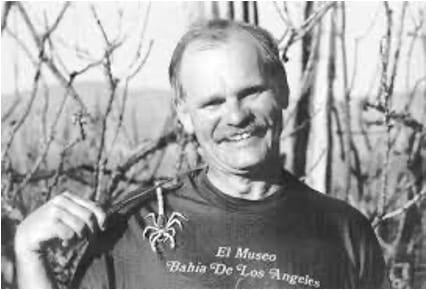
Bill Boivin is a scientist, retired from 30 years of active duty with the United States Public Health Service. He is a Burlington Town Meeting Member and Conservation Commissioner. He and his wife, Jane, grew up in Lynn and now live in Burlington with their 2 mini dachshunds, 7 chickens, and Maya, a ball python. Bill and Jane have shared a love of nature, gardening, and wildlife for over 50 years. They have fostered, healed, raised, and loved a remarkable variety of animals in their time together. Learn more about Bill.