
Raising a Baby Raccoon: How Brown Eyes Became Our Favorite Houseguest
How an unexpected visitor became a favorite friend

(The word raccoon is from the Algonquian arathkone or arakun, meaning “scratches with his hands.”)
Late one night, a friend and her son unexpectedly appeared on our doorstep. The little boy was holding a box. “We tried two or three shelters and none were open,” they said. “You are our last hope.”
In the box was a baby raccoon, eyes closed, limp and lifeless. It was thin and barely breathing. The hour was late; Mom had to get her son home to bed. Knowing our history of rescuing and reviving small animals, they had brought it to us.
“We’ll see what we can do,” we said.
We set an electric heating pad on low and placed it under a cardboard box with a towel in it. We gently placed the limp little beast in there, and draped another towel over the top. Off to bed we went, with not much hope for the morning.
I got up extra early to see how the little one was. I gently lifted a corner of the top towel and peeked inside. Looking right at me was the tiny kit, standing on his rear legs. “What’s for breakfast?” he seemed to say. I could not believe it!
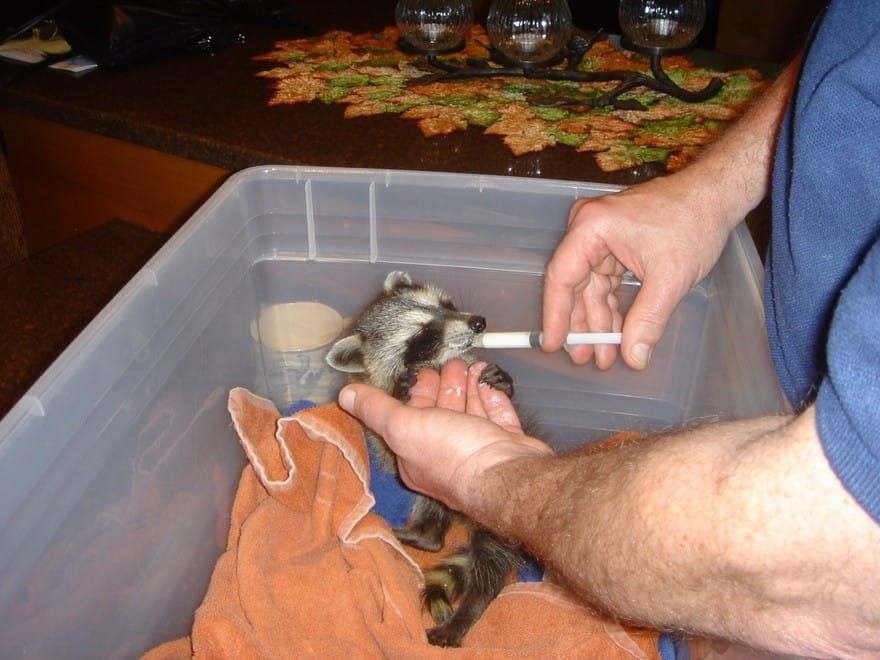
The first thing we did was bottle feed him some warm water with a little honey in it. The second thing we did was to search our bookshelf for information on what the heck to feed a baby raccoon. It was 2007; we were not yet proficient in internet searching, so our best resource was our personal library of animal reference material. We have dozens of books on animal identification and habitat but only one specifically on raising wild animals (Care of the Wild Feathered and Furred, Mae Hackman and Maxine Guy, 1973). Cow’s milk was said to be acceptable, so we made up a bottle for him. He was an eager eater.
After a week or two of bottle-feeding him, we upgraded to pureed baby food from Shaw’s – chicken flavor and veggie flavor – which he eagerly accepted.
The folks who had dropped him off stopped by to see his progress. I asked four-year-old Jesse what he thought the raccoon’s name should be. He said, “Brown Eyes,” so that's what we named him.
Of course, I had to take Brown Eyes to work with me to maintain regular feedings.
I kept him in a portable cage behind the desk in my office. People could come into my office and not know he was there. However, a few colleagues had seen me entering the floor with a cage. Word spread fast, and soon I was getting a parade of visitors.
When someone asked to see the raccoon, I would close the office door and let him out. Brown Eyes was very tame and friendly. You could handle him, cuddle him, and let him crawl all over you. He was a big hit.
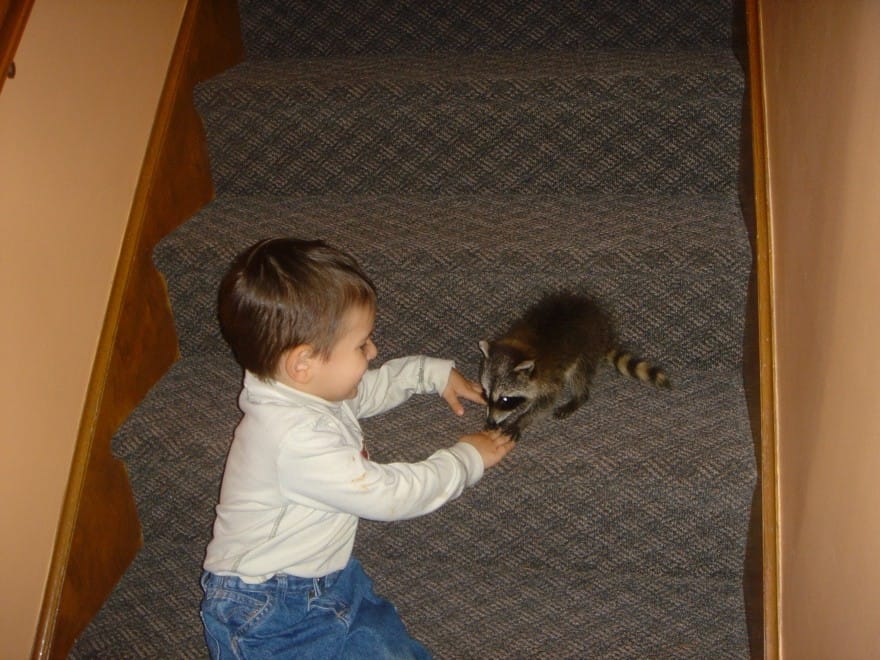
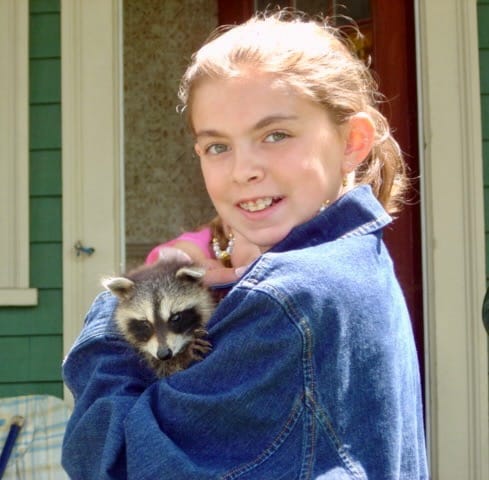
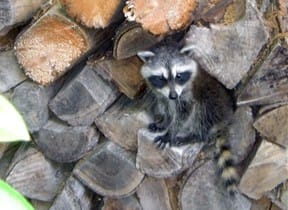
Brown Eyes was friendly with everybody
It only took about two work days before the big boss, the District Director, came into my office and said, “What are you keeping in here now, Bill?”
I showed her the baby raccoon.
She said, “You know I cannot approve of him being here, right?”
I assured her it would be very short term – only until I was certain the baby could eat on its own at home.
Her official decision: “If I get one complaint, it’s out!” No one ever complained.
In some ways, Brown Eyes was the perfect pet. He was easy to care for, liked to be held, and got along great with the dogs. We could even take him out in the yard for little walks. I learned at the time that baby raccoons are like ducklings – they follow Mommy in a single-file line. Jane would walk around the property with her morning coffee, trailed in line by our two dogs with the baby raccoon bringing up the rear. It was adorable – a little parade going around the gardens. If Brown Eyes wandered off into tall plants and couldn’t see Jane, he would cry. Jane would make a little clucking noise, and he would come running.
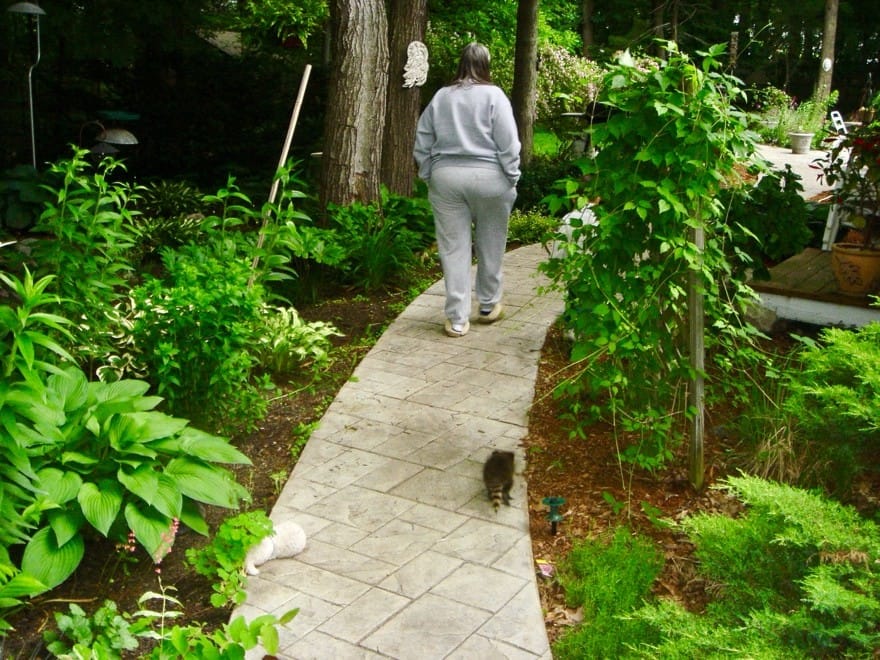
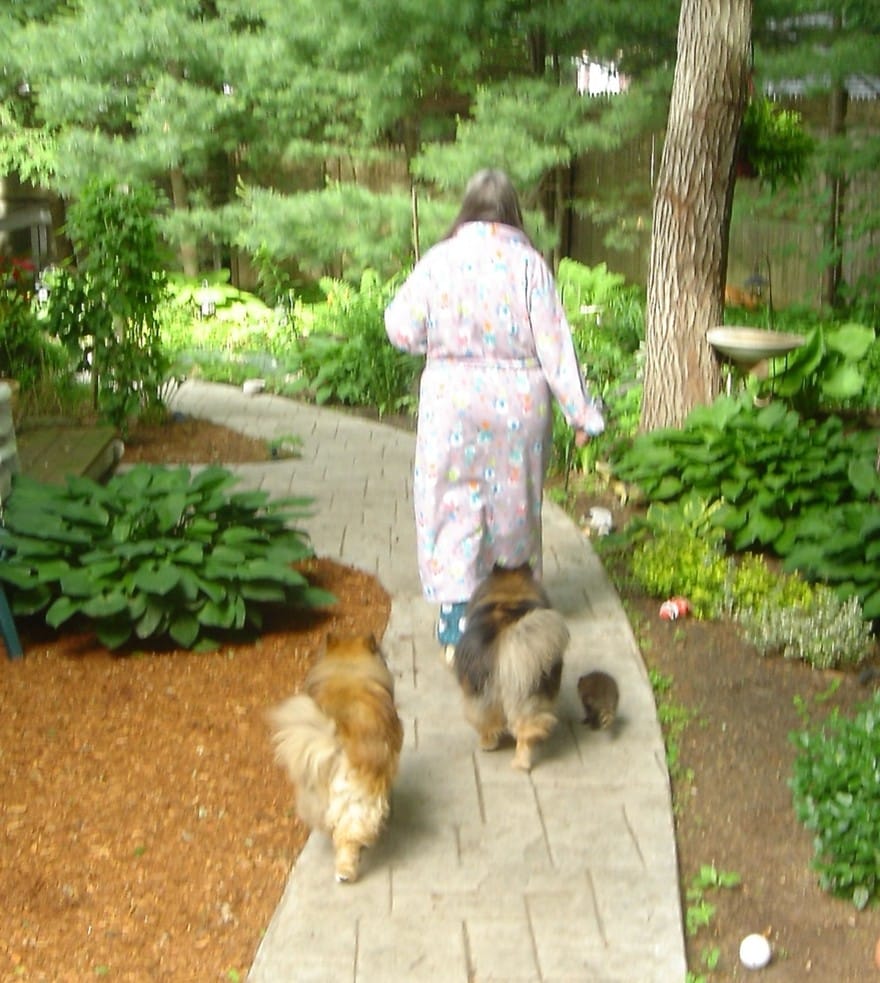
Left: Brown Eyes followed Jane everywhere. Right: Jane on her morning garden walk followed by (L-R) Angel, Lewis, and Brown Eyes.
We had Brown Eyes for 5 or 6 months. He progressed to a large ferret cage outside in the garden. He was eating greens, fruits and nuts. We tried to ensure his diet resembled what he might find in the wild, as we planned to release him someday.
Our preferred plan was to just open the cage door, leaving it open with food inside so he could come and go as he wished. In our wildest dreams we envisioned a semi-tame long-term local area resident.
However, we had not seen a raccoon around our neighborhood in a decade. The rabies epidemic of the late 90’s had caused a significant decline in the raccoon population in Massachusetts. We did not relish the thought of releasing him somewhere devoid of any contact with members of his species. We decided to bring him to the New England Wildlife Center (NEWC) in Weymouth. Their strategy was to ensure he was ready for release and to let him go in the exact location where he was found. We determined that location from the folks who brought him to us and relayed the information to NEWC.
Sadly, that was the last we saw of our little friend, Brown Eyes — but we like to think he found his way back to exactly where he belonged.
Bill Boivin is a scientist, retired from 30 years of active duty with the United States Public Health Service. He is a Burlington Town Meeting Member and Conservation Commissioner. He and his wife, Jane, grew up in Lynn and now live in Burlington with their 2 mini dachshunds, 7 chickens, and Maya, a ball python. Bill and Jane have shared a love of nature, gardening, and wildlife for over 50 years. They have fostered, healed, raised, and loved a remarkable variety of animals in their time together. Learn more about Bill.