The Pocket-Sized Artifact That Connects Burlington to Centuries of Presidential History
by Peter Coppola, Burlington Historical Commission
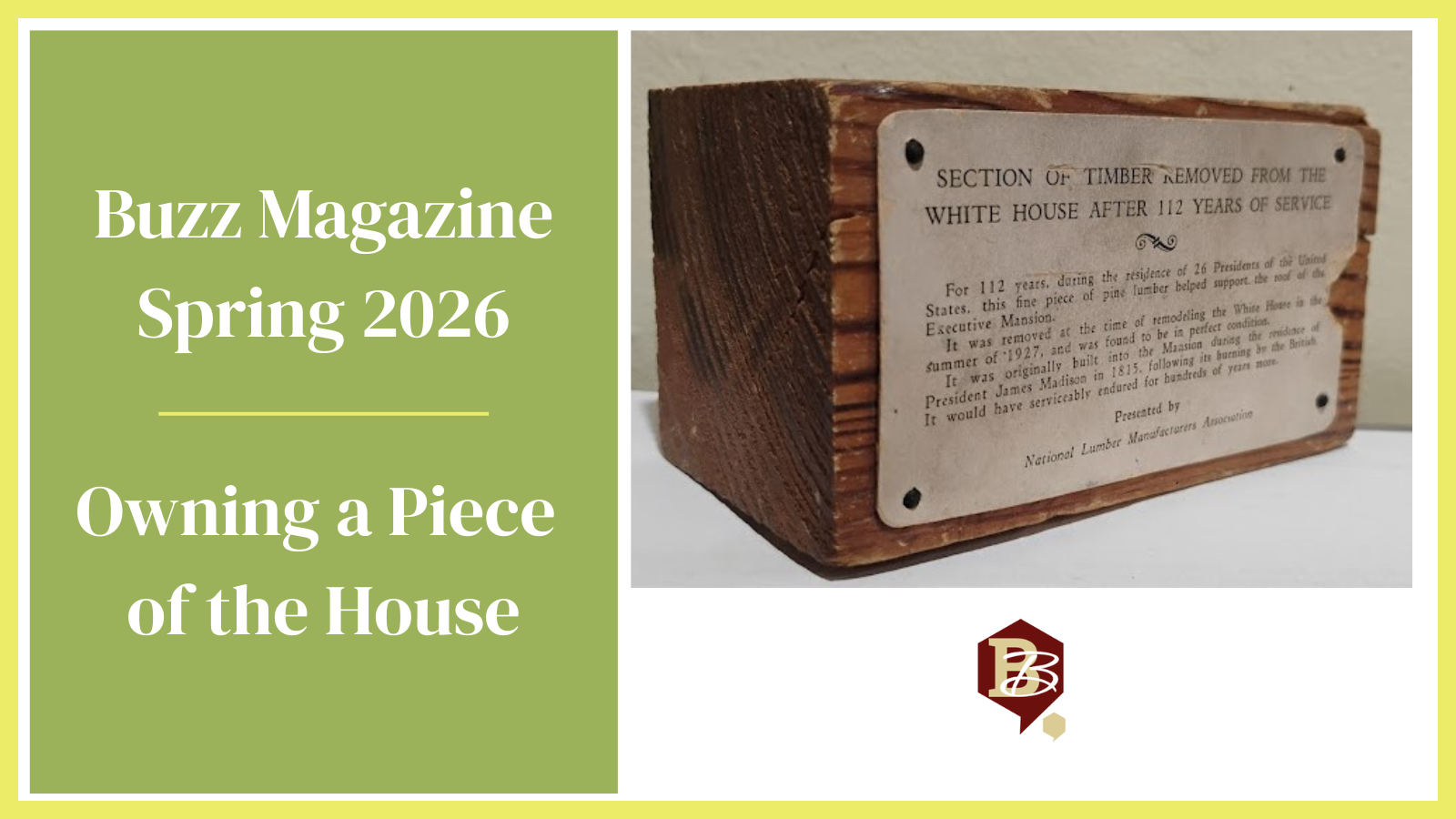
A few years ago, a small block of wood measuring just 4” x 2.25” x 2.25” sold at auction for $2,400. Why would someone pay more than two thousand dollars for something small enough to fit in a pocket?
Because that block of wood was once part of the White House.
It had been removed during the building’s 1927 renovation, authorized under President Calvin Coolidge. And while most of us will never own a piece of 1600 Pennsylvania Avenue, Burlington quietly does.

This story was featured in our Spring Magazine
Read our Spring 2026 issue today — now arriving in Burlington mailboxes.
Over its more than 200-year history, the White House has undergone several major renovations. After the British burned it during the War of 1812, President James Monroe oversaw its reconstruction beginning in 1817, completing work begun under James Madison. In 1901, Theodore Roosevelt added the West Wing to create a separate workspace for the presidency. William Howard Taft expanded it in 1909, introducing the first Oval Office, later relocated and redesigned by Franklin Roosevelt in 1934. Roosevelt also added an underground bunker and constructed the East Wing above it in 1942.
By the late 1940s, structural deterioration forced President Harry Truman to gut and rebuild the interior entirely.
It has been over two centuries since the White House’s post-fire reconstruction. Yet wood blocks, gavels, canes, and pieces of furniture, made from lumber removed during Coolidge’s 1927 renovation, are still kicking around – and one such block eventually made its way to Burlington.
Today, it sits in a display case at the Burlington Historical Museum – a sister piece, complete with matching end grain, to the one that fetched thousands at auction.

If you like being informed and connected to your community, sign up for the Daily Buzz newsletter now!
How the block traveled from Washington to Burlington remains unclear. An auction in 1928 awarded most of the removed lumber to the National Lumber Manufacturers Association, which then distributed many of the pieces as souvenirs.
Ironically, the 1927 renovation was prompted not by decay in the wood itself, but by concern that the structure might collapse under the weight of presidential archives stored in the attic. The timber, says the attached placard, could have lasted centuries longer.
The White House has weathered war, expansion, modernization, and reinvention. Here in Burlington, visitors can see—and quite literally stand before—a small but tangible fragment of that history.
Keep an eye on Burlington Buzz for upcoming museum open hours, and if you’re curious about other presidential relics, additional information about White House renovations can be found at whitehouserelics.com.