Two Burlington High Juniors Helped Write a National Student AI Bill. Now Beacon Hill Wants to Hear It.
Kanika Agarwala and Shayla Ruiz represented Massachusetts at a national student AI summit. Now, state Rep. Ken Gordon wants them to testify on Beacon Hill.

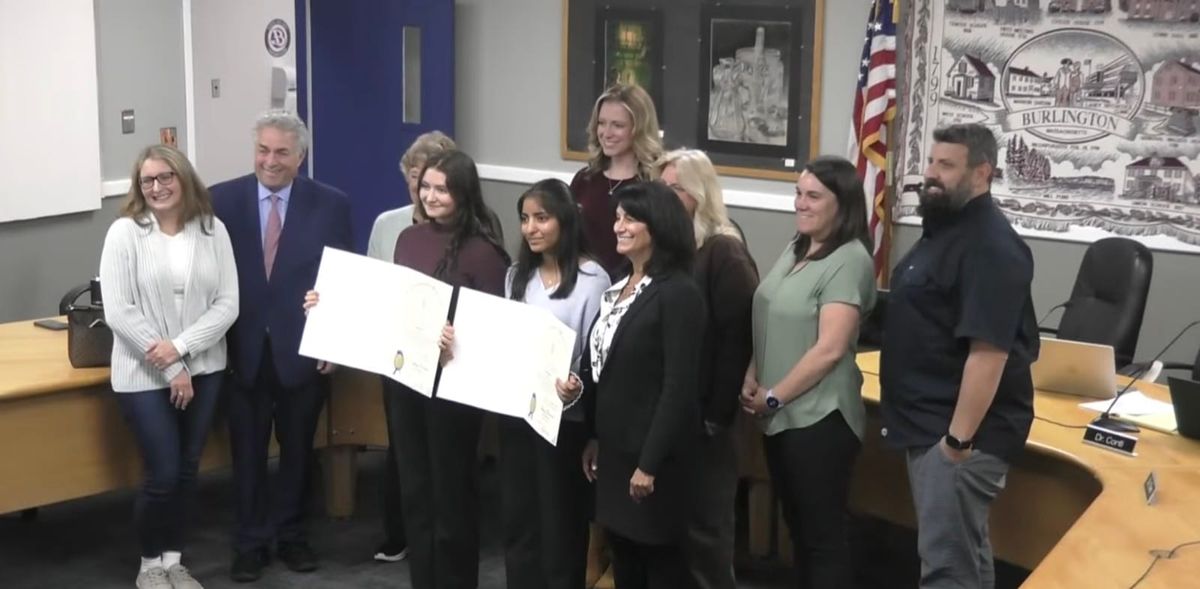
This July, two Burlington High School juniors spent three days in a replica U.S. Senate chamber debating how artificial intelligence should work in schools. At the Sept. 22 School Committee meeting, they told their hometown what they came away with. A state lawmaker wants them to tell Beacon Hill, too.
Superintendent Eric Conti told the School Committee that schools missed their chance to talk about social media before it became ubiquitous, and that many young people worry adults are moving too slowly on AI. The summit was meant to start that conversation early.
Burlington has been thinking about AI for some time. Under the leadership of Director of Career Pathways Shereen Tyrrell, the district ran the High School Summer Career Academy in AI in 2025 and 2026, drawing students from BHS and beyond to learn how AI is used in the workforce. Conti said Burlington students have now left their mark on model legislation aimed at putting guardrails in place for the safe and informed use of AI in schools.
Kanika Agarwala and Shayla Ruiz were Massachusetts’ two student senators at the inaugural Student Senate, held at the Edward M. Kennedy Institute for the United States Senate in Boston. They collaborated with students from all 50 states to draft and vote on the STUDENT FIRST Act, a model bill covering how students, parents, teachers and administrators should handle AI in K-12 schools. America's Youth AI Festival, hosted July 17-19 by Day of AI, MIT RAISE, AASA (the School Superintendents Association) and the Kennedy Institute, ended with the bill passing 82-16.
Three days in the chamber
Ruiz said a wide range of communities and schools were represented alongside the 900-student BHS, from a school with four students in Kentucky to one with 100 in Kansas. Student senators split into four subcommittees (student, parent, teacher and administrator), drafted provisions, then debated each one before the full Senate. The first day was the longest and most tiring, Ruiz said, with hours of debating and revising ideas.
What’s in the bill
Among the provisions of the STUDENT FIRST Act:
- AI literacy from the start. Schools would teach how AI works, including bias, misinformation and privacy, beginning when students first use classroom devices.
- Teacher training. Teachers assigning digital work would complete a state AI literacy course every two years. Agarwala said the goal is for teachers to understand AI well enough that they’re not just saying “no AI ever.”
- Families in the loop. Parents would be told every year how AI may be used in the coming school year and would sign off before it begins.
- Student data. Students must be told what data is collected and can refuse unnecessary collection. Schools can’t use AI to profile them by ethnicity, religion, appearance or beliefs.
- Fairness. Students accused of misusing AI could appeal, with human review of their work.
The Burlington students said AI literacy, teacher training and regular communication with families were among their priorities.
Ruiz said the bill balances “protection against AI” with its “innovative capabilities.” She said the lesson she’s bringing home is perspective. “It really instilled in me how important each and every person’s point of view really is.”
“I think AI is changing every single aspect of our lives,” Agarwala said. As a district, she said, Burlington should move forward while protecting students and encouraging them to learn new technology.
Tyrrell, who attended with teachers from across the country, said the students’ closing speeches moved the adults to tears.
From Kennedy Institute to Beacon Hill
At the meeting, state Rep. Ken Gordon, House chair of the Joint Committee on Education, presented both students with House citations signed by Speaker Ron Mariano. He said he is pushing to make AI literacy part of the “portrait of a graduate” – the state’s emerging standards for what graduates should know.
He compared AI to electricity, something this generation will live with. Restricting or banning it “makes no sense,” he said. That would be the easy route, but “that’s not the direction that we’re going to head in Massachusetts.” He invited the students to testify before the committee, and they agreed.
What it could mean for Burlington
Conti reminded the School Committee that setting policy is one of its core jobs and asked members to look at the students’ language for Burlington. He acknowledged the topic is complex and addressing it will require ongoing work. School Committee Chair Katherine Bond said parents want a voice and urged the district to seek input from a variety of stakeholders “instead of just us doing this in a silo.”
Conti pointed to the committee’s policy subcommittee as a possible home for the students’ language. No dates were announced for the students’ testimony or the district's next policy subcommittee meeting.