Catching a Phantom in the Forest
On an Earthwatch expedition to the Brazilian Pantanal, a team of citizen scientists netted a bird that had never been banded in Brazil: the “phantom” pheasant cuckoo.

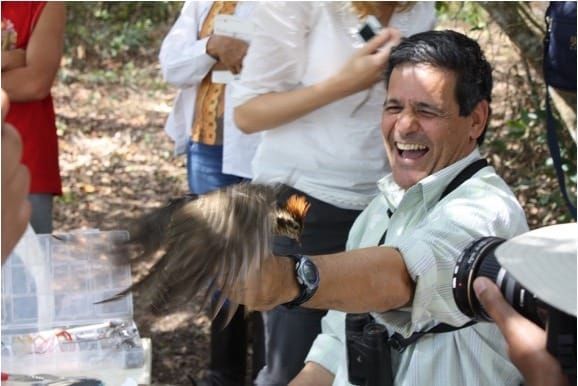
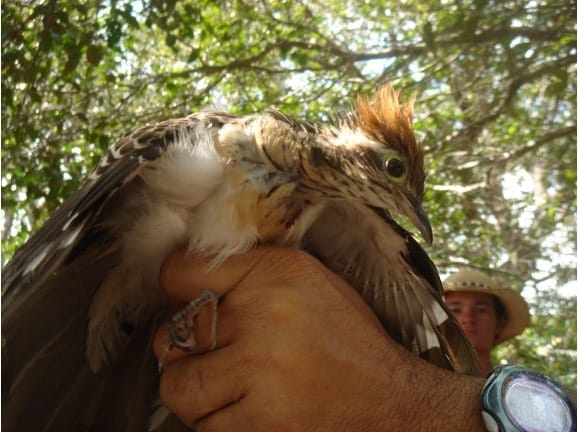
Dr. Reginaldo Donatelli screeched in delight, sounding like a child opening his favorite Christmas present ever. The rest of the team ran over to see what the excitement was. A “phantom cuckoo” was caught in our net!
Officially called the pheasant cuckoo, this elusive bird is often called a “phantom” because, while its cries are occasionally heard, sightings are exceptionally rare. For Donatelli, it was the greatest capture of his career, and the first time that bird had ever been captured and banded anywhere in Brazil. Before releasing the cuckoo, he recorded a video lecture while holding it.
We were a team of eight Earthwatch volunteers on an expedition to assist in field research into bird life in the Brazilian Pantanal, and "Reggie" Donatelli was our ornithologist team leader.
Earthwatch, a nonprofit that pairs paying volunteers with working scientists, allows regular people to assist in a scientific study while traveling to beautiful places far from home. In one week, our team:
- Documented 219 species of birds
- Captured 81 birds in nets representing 31 species
- Added 5 new species to the Pantanal bird inventory for this area
- Added one new species to the Pantanal overall inventory (crested doradito)
- Captured and banded the first pheasant cuckoo in Brazil
The valuable information our team of citizen scientists collected contributed to related environmental studies investigating the impact of cattle ranching on the Pantanal habitat. Our group was tasked with collecting data in an area that had no cattle ranching. Others were looking at areas with traditional cattle ranching, where cattle were brought in and allowed to roam freely. A third group would be examining the effects of intense cattle ranching where the land was cleared and grasses were planted to feed the cattle.
Our work in the three classes of areas would give environmentalists actual scientific data about the impacts of land clearing on wildlife and whether traditional cattle ranching could be a more environmentally sound approach.
The Pantanal in west central Brazil is the largest wetland in the world and a UNESCO World Heritage site. It was the furthest my wife Jane and I had ever been away from home together. We took a 21-year-old scientist friend, Denise, with us to get her out of the lab to experience science in the field.
I had just stepped off the tiny plane after a brief flight to the grass landing strip at our research base when I saw a pair of scarlet macaws only a few yards away. It was so exciting! Not five minutes into the trip, and I’d already checked an item off my bucket list.
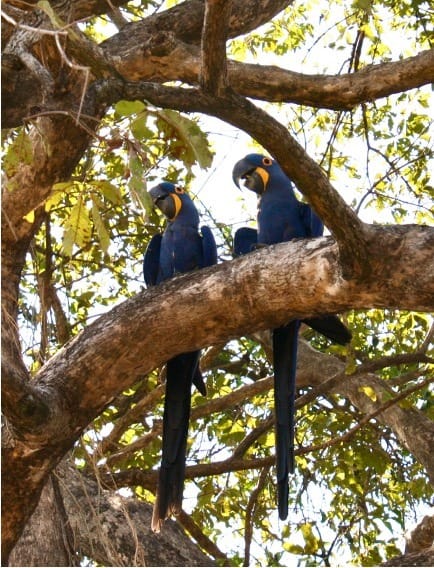
Our remote location, “virtually uninhabited by humans,” according to our expedition briefing, was also one of the largest remaining concentrations of one of the rarest and most beautiful birds in the world, the hyacinth macaw. At over three feet in length, with a four foot wingspan, the hyacinth is the largest of all macaws. During our time there, we became used to seeing a few of these stunning creatures every day.
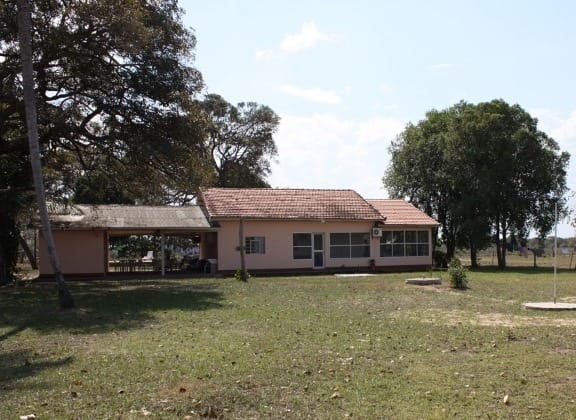
Compared to our two previous Earthwatch expeditions, this one had luxury accommodations: a small screened-in camp lodge with actual beds. (All four male volunteers in one bedroom, the four women in the other). Good news: it had showers and flush toilets. Excellent news: cooks prepared three fabulous meals every day. The eight Earthwatch volunteers were from all over the globe: USA, Germany, Australia, the Netherlands, and India.
The two weeks were split into two separate research studies: First we studied birds, then the next week we looked at bats. The first week, using mist nets to capture birds, was very similar to our Panama Earthwatch experience. The very fine nets were strung up for prescribed periods in daylight hours and checked hourly for captured birds. Two sites were selected for netting: one on the shore of the Rio Negro and the other further inland. Since all nets were ground level (approx. 8’ high), we only captured birds in the understory; those living in the canopy (like macaws) could only be identified by sight or sound.
We were accompanied on daily excursions by Reggie, two or three native guides, and a couple of Reggie’s graduate students. We recorded data including species, gender, health, evidence of a brooding patch, and any existing bird bands. All were banded and released. Where possible, audio data of bird calls were collected when a bird was visually identified. Previously recorded bird calls were also played to see if we could attract other nearby species members and verify their presence in this area. (I was always surprised when that worked.)
One day we cruised the marshes of the Rio Negro in a small powered skiff, stopping often to shut off the motor and listen for bird calls. Reggie was a master of bird call identification, giving us more data on which birds lived there. That, and bird sightings, is why the “documented” species number is greater than the "captured" species in the data above.
The local caiman were particularly fun animals. There would be dozens basking in the shallow swampy river border right near our mist netting station. Denise was by far the best at quietly and slowly getting close enough to caiman that they would bark at her. For everyone else they scooted off without barking. This became a favorite way to pass the time between hourly net visits.
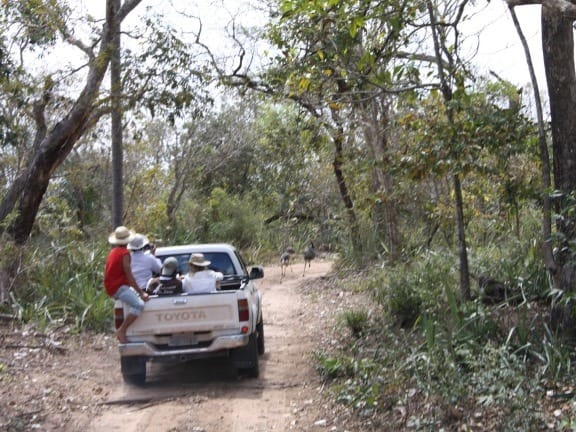
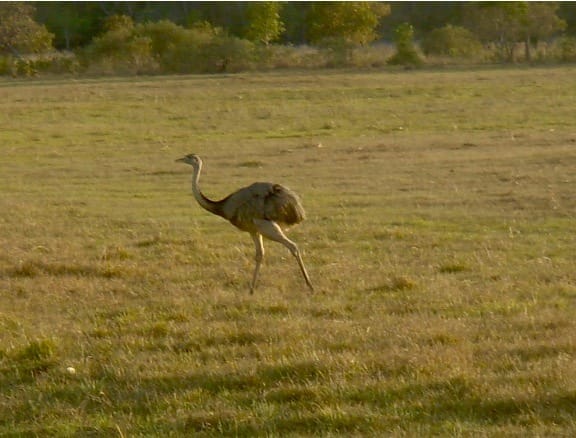
Left: Our lead vehicle pursuing a flock of rhea. Right: A solitary rhea.
Driving to and from the netting site provided opportunities to observe some wildlife. We occasionally saw rhea, which are ratite birds similar to ostrich and emu.
On one drive, as we drove by a grassy upland area, Reggie spotted a giant anteater in the center of a field. The volunteer from India, “Vee,” and I both launched ourselves over the edge of the vehicle bed and took off on foot with the goal of gently corralling the beast towards the truck so we could get photo documentation. We were successful! My favorite photo of the trip captures this effort.
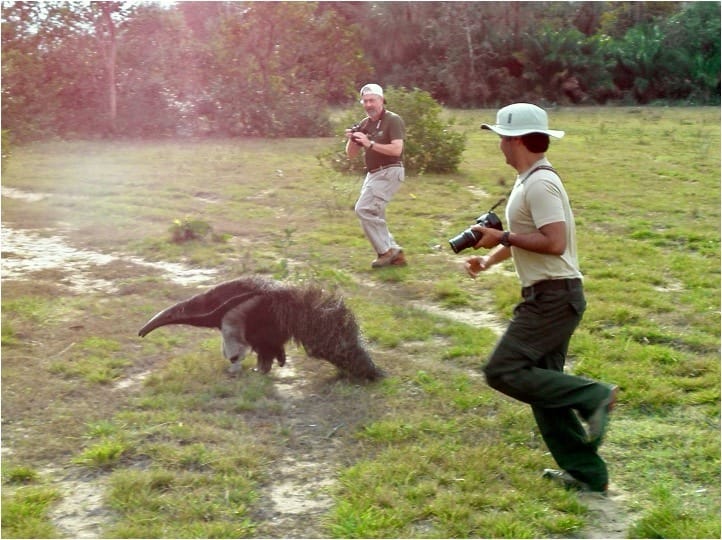
At our close-out dinner on the final day, each of us was asked to state a favorite moment. Both Vee and I said that getting close to a giant anteater was our highlight.
About a month later, Dr. Donatelli’s summary field report arrived with the final numbers. By the end of our week studying birds, a handful of regular people with mist nets and notebooks had added real knowledge about one of the world’s great wetlands, and those data helped inform other scientific studies.
Donatelli’s papers on bird distributions didn’t address cattle ranching directly. But they helped establish an undisturbed baseline for what bird life looks like where there is no cattle grazing, and his work informed studies on how low-intensity grazing can coexist with biodiversity conservation.
It was a week of science, nature and camaraderie, and a reminder that you don’t need a lab coat to contribute.
And that was only week one. For week two, we traded birds for bats. Wait until you read my next column to find out what we learned.
Bill Boivin is a scientist, retired from 30 years of active duty with the United States Public Health Service. He is a Burlington Town Meeting Member and Conservation Commissioner. He and his wife, Jane, grew up in Lynn and now live in Burlington with their 2 mini dachshunds, 7 chickens, and Maya, a ball python. Bill and Jane have shared a love of nature, gardening, and wildlife for over 50 years. They have fostered, healed, raised, and loved a remarkable variety of animals in their time together. Learn more about Bill.