Burlington Police Collaborate With Schools, Community Members to Raise Awareness Amid Rising E-Bike Use
From school presentations to Chick-fil-A gift cards, local officers are finding creative ways to teach kids — and parents — the rules of the road.


The Burlington Police Department has been working this summer to address the growing issue of electronic bikes and scooters in the community and, on August 17, 2026, Sergeant Matt Creamer appeared before the Select Board along with BHS Youth Services Detective Dan Murphy and Marshall Simonds School Resource Officer Dominic Calicchio to explain the concern and how the Police Department is addressing it.
Creamer said the increased prevalence of e-bikes has led to an uptick in complaints from community members. If not used appropriately, e-bikes can lead to serious injury or death; this has been seen in nearby communities as accidents involving children riding electronic bikes and scooters have made the news in recent months. There have even been several accidents here in Burlington, said Creamer, though none have been serious. "When we're talking about fatalities resulting from e-bike crashes, the number one demographic that's falling victim to that are 10- to 13-year-old boys," he said.
With that in mind, the Department's youth services officers are leading an education campaign for students, adults, and community members to ensure the community is aware of the use requirements for electronic equipment and that operators are following the rules to keep themselves, other motorists, and pedestrians safe.
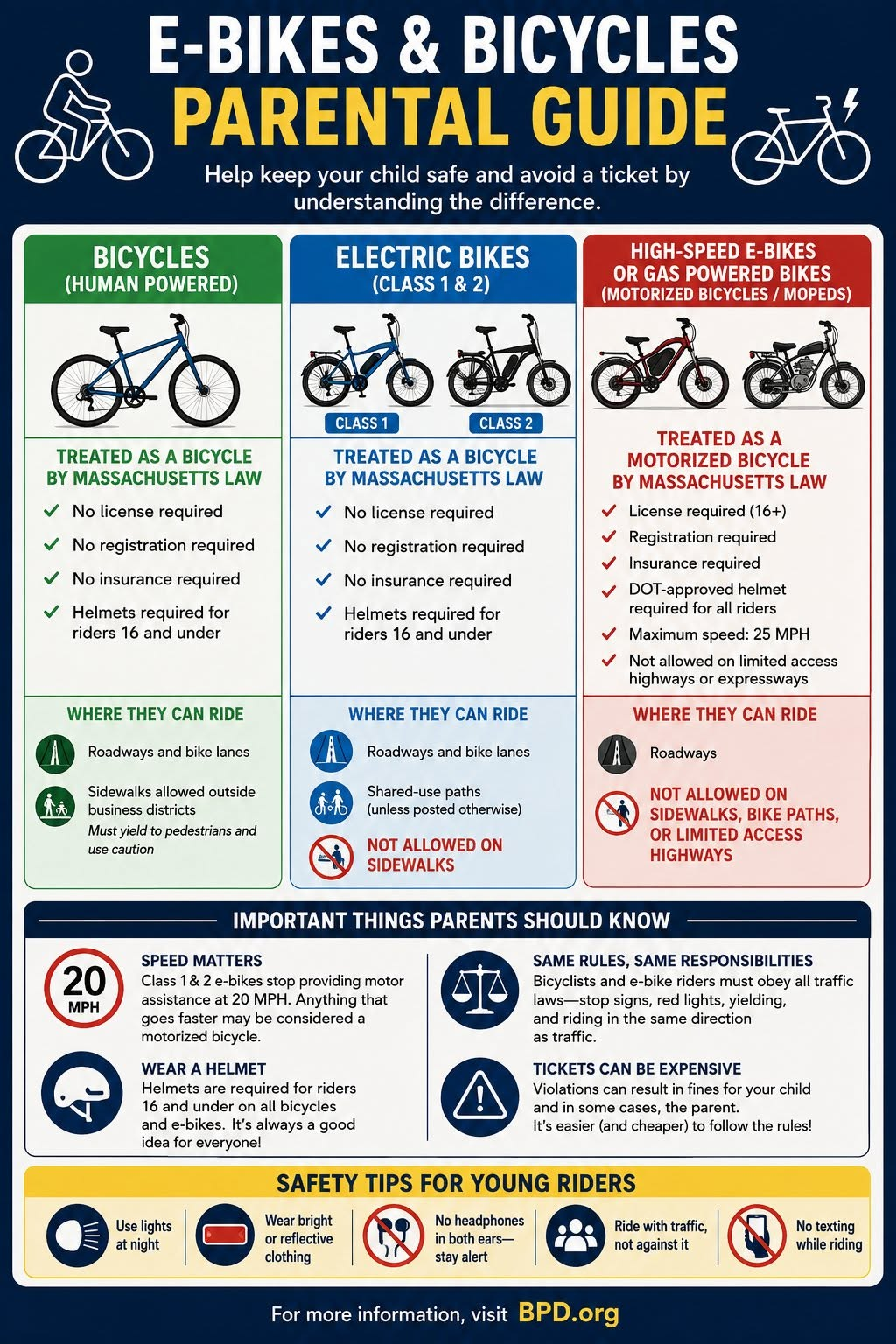
One problem, said Creamer, is that parents aren't always aware of e-bikes' capabilities when they purchase one for their child. Class 1 and Class 2 e-bikes can go up to 20 miles per hour and are subject to most of the same rules as bicycles – including a helmet requirement for anyone 16 and under – but, unlike bicycles, they aren't allowed on sidewalks even outside of business districts. However, said Creamer, what starts as a sub-20-mph Class 1 or Class 2 e-bike can easily be modified after purchase to go faster than the maximum allowed speed. These modified e-bikes are treated as a motorized vehicle under state law and require a license, registration, and insurance.
Community concerns, said Creamer, center on "young riders operating at high speeds, riding recklessly, riding on sidewalks, disregarding traffic controls, and in many cases riding bikes that appear to have been modified well beyond what Massachusetts considers a legal Class 1 or Class 2 e-bike." At speed, Creamer said, these devices have a much longer stopping distance than a pedal bicycle and can create hazards for other vehicles and the rider.
But rather than banning the devices altogether or engaging in punitive practices, the Police Department is seeking to spread information throughout the community. "Our youth services are working to educate especially our middle-school-aged students about safe operation, traffic laws, helmets, [and] the risks associated with high-speed or modified devices," said Creamer.
The Department created a flyer explaining the difference between bicycles, Class 1 and Class 2 e-bikes, and motorized bicycles under state law and is distributing it through their social media channels; the same flyer was sent to parents and families via the ParentSquare communication platform.
At the Police Department's 55th annual Safety Town event this year, officers talked with kids about safe use of electronic bikes. Additionally, Calicchio plans to make presentations at the town's schools to make sure all kids are aware of the rules regarding bikes and e-bikes.
Officers are also making efforts to talk with kids who are obeying the law, rewarding kids who are using e-bikes and helmets appropriately with Chick-fil-A gift cards. "We want people to talk about it so that if one kid knows all the rules, he can correct his friends and then it kind of spreads from there," said Calicchio.
The goal: to raise awareness before tragedy strikes in Burlington.
"We want these conversations to happen before the child is involved in a serious crash, for obvious reasons," said Creamer.
Enforcement of these rules can be challenging, said Creamer, as kids don't always stop for police, and pursuit can create an even more dangerous situation. That's why the campaign is centered on information with the hope for voluntary compliance, with targeted enforcement when necessary.
Select Board members expressed appreciation for the update and shared the community's concerns. While it could be easy to call for a complete ban in light of the concerning incidents in nearby communities, said Member Sarah Cawley, "We have to accept them as part of our transportation infrastructure." She acknowledged the devices allow more independence for kids and better accessibility for people of all ages and suggested transportation infrastructure needs to evolve as these devices become more prevalent.
Creamer said the Department's primary goal is to build relationships, share information, and incentivize good behavior to keep all community members safe. "E-bikes can be a great form of transportation around town when they're operated properly within the law," he said.
More information about e-bike safety can be found on the Massachusetts Safe Routes to School website.