Where the Reef Begins: A Belize Adventure Beyond the Resort
A relaxing resort vacation becomes a once-in-a-lifetime adventure

Belize, 1992. After four whirlwind days exploring the mainland with an accidental private guide named Marcel, my wife Jane and I boarded our plane in Belize City for the second half of our 8-day vacation.
We took off for the resort on Ambergris Caye on a small plane. How small? One of the pilots came back and asked if I could move to the other side of the plane “to balance the load.” There were only four of us on board with capacity for perhaps double that. We could hear the pilots’ entire conversation owing to the lack of a cockpit door. Mostly it centered around their desire to get assigned to a bigger plane and a better route.
It was a short flight to the island’s tiny airport. How tiny? The first attempt to land was aborted “so someone could get the dog off the runway.” (The runway was the only paved road around, so the dogs liked to bask there.) There was laundry hanging from the tiny control tower.
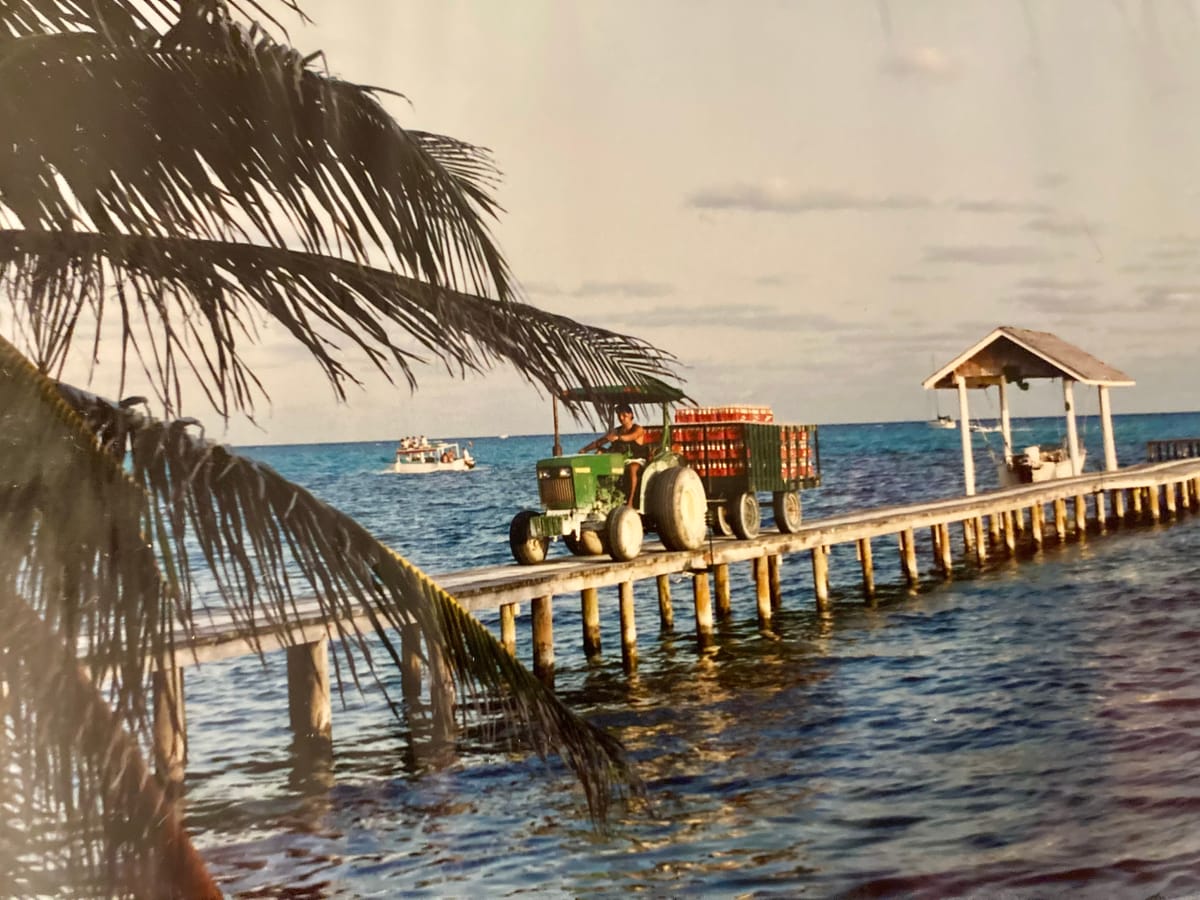
The accommodations were a classic beach resort called Ramon’s – we had a private, thatch-roofed hut on stilts right over the water. There was a large pier where we could sit in chairs near the end and a lovely open-air dining area/bar.
The first day was uneventful aside from the sunset “chicken drop contest” at a nearby resort. The arena for this silly game was a 10x10 grid on the ground about the size of a boxing ring. Players bought one or more of the 100 squares, then a chicken was dropped in the middle. The first square it pooped on was the winner.
The next day we signed up for a three-hour snorkeling trip on a beautiful catamaran. I couldn’t wait; I love snorkeling. I cannot swim, but with a mask on I can float effortlessly. After accounting for travel, passing out equipment, instructions, snacks, and the return trip, we barely spent 45 minutes in the water and did not see much. It was very disappointing.
When we got back to shore, we remembered that our mainland guide, Marcel, had told us he studied marine biology, and we had his business card. We took a chance, asking the resort manager to help us make the phone call. Lo and behold, Marcel answered. I asked him if he could come to our location and give us a private snorkeling tour. He said yes! He cautioned that it would take his cousin and him about three hours to get to Ambergris Caye in his small skiff and the gas alone would cost $300. Our response was instant. “We want you. Let’s do it!”
Marcel and his cousin arrived at our resort early in the morning. The first thing we did was take them to breakfast at a small local diner Marcel knew of. Halfway through the meal, Marcel said, “Excuse me, I want to go say hi to that guy over there.” When he came back, he was giddy with excitement, “Do you know who that was?” Of course, we did not. “That’s the prime minister of Belize!” Marcel was a mover and a shaker, always networking, passing out his business card and shaking hands, playing the game in hopes of reaching his goal of someday owning a private hunt club.
After breakfast we packed snorkels and sandwiches and headed out to sea. Marcel hugged the coast. He pulled into a shallow area at another island. “We start here.”
“Why?” we asked; the water was barely waist deep.
“This is where it all starts,” he said. “The mangrove swamp.” Bent over with our masks in the water, we could see millions of tiny fish (called fry). Fry of many fish species start their lives here. The mangrove roots were very dense, offering the fish protection from larger predators and preventing us from swimming among them. We only spent 15 minutes or so there, but it was eye-opening.
Back in the boat, our destination was a national park containing the second largest barrier reef in the world, the Belize Barrier Reef. (Great Barrier Reef in Australia is #1.) From my viewpoint, there was nothing but open water ahead. No landmarks of any kind. Abruptly Marcel stopped and anchored the boat. We went in to snorkel again. It was about 20 feet deep and nothing to see but sand, sand, and more sand. An occasional blenny popped its head out of the sandy bottom, but that was it. Why did we stop there? Marcel wanted us to see what most of the sea bottom here looks like. He was not just taking us snorkeling; he was teaching us marine ecology.
Cruising across the open water, we saw things we’d never seen before. A school of hundreds of small pencil fish emerged, skipping rapidly over the surface, almost air borne, before disappearing. Three or four huge 3,000-pound manta rays breached like whales! I did not even know they did that. These massive fish would emerge completely out of the water, flap their wide fins as if trying to fly, and bellyflop back to the surface with an enormous splash. We were close enough to feel the wake of the waves they created. Just astounding!
At one point, Marcel stopped the boat and said he was getting out, but we were to stay. He dove down deep and came up with a conch. It was not occupied, so he tossed it back. He tried again, but the next was too small to legally take. The third time he accomplished his quest, tossing the living conch into the boat.
He climbed into the skiff, grabbed his machete, hacked the conch in half, dug into it, and tore out a bit of flesh. He handed a piece to each of us saying “eat this quick.” We did. We had just eaten the beating heart of a conch, said Marcel, and thereby absorbed its beneficial life energy. Wow, this snorkeling trip was nothing like yesterday’s!
We pulled up anchor and headed towards the reef once more. About a half-hour later, another small boat appeared,m with a ranger inside who said we had to pay $1.50 each to enter the Hol Chan Marine Reserve. With nothing but open water everywhere, I do not know how the ranger knew where the reserve began and ended, but he did.
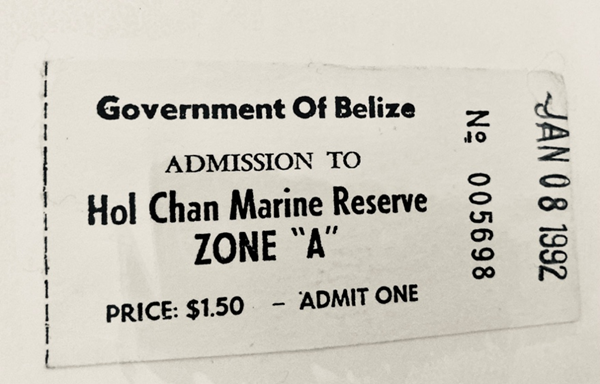
Shortly thereafter, we reached our destination. Marcel dropped anchor 100 yards from the reef.
The reef itself peaked only a few feet below the surface. It was a “barrier” reef, acting as a breakwater and creating a calmer harbor inside its arc. The harbor was very large; we could barely see the shore. There was a channel carved through the reef, allowing boat traffic to safely traverse the shallow reef. The tide was going out, so the channel was funneling a significant current outward from the harbor.
If we were to get into this current, Marcel said, we shouldn’t try to swim against it. He also told us not to stand on the shallow but very sharp coral; it was dangerous, and you could damage the coral. If we got caught in that current, we were to just let it take us to the other side of the reef where Marcel could easily get us with the boat. After hearing that comforting description, Jane decided that she would relax and read a book in the boat. Marcel, his cousin, and I hit the water.
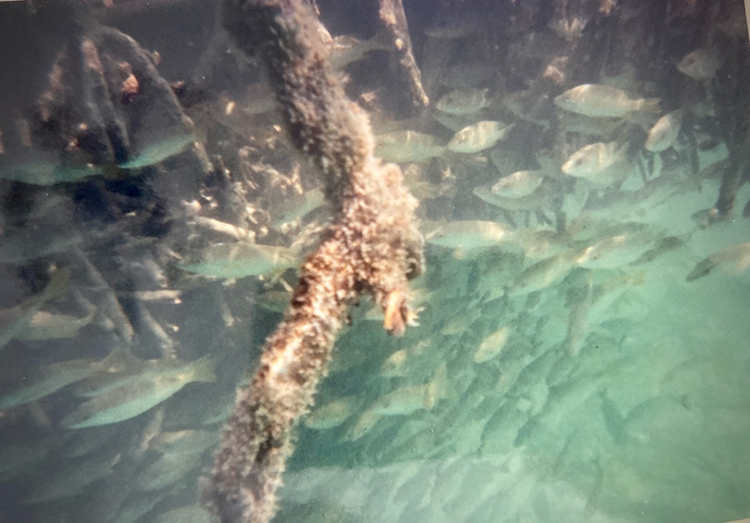
The boat was surrounded by fish, and the snorkeling was phenomenal. Because we were going to spend the day on and in the water, the only camera I had was a tiny disposable waterproof one I had purchased at the resort. What a shame; only a few underwater pictures came out remotely usable.
Life was everywhere. Around the reef I saw Yellow-tailed snappers, pencil fish, a sting ray, a nurse shark eating a conch, a very large barracuda, an enormous 600 lb Atlantic Goliath grouper, squid, an octopus eating a conch (I guess it was not a good day to be a conch.), and so much more. It was breathtaking.
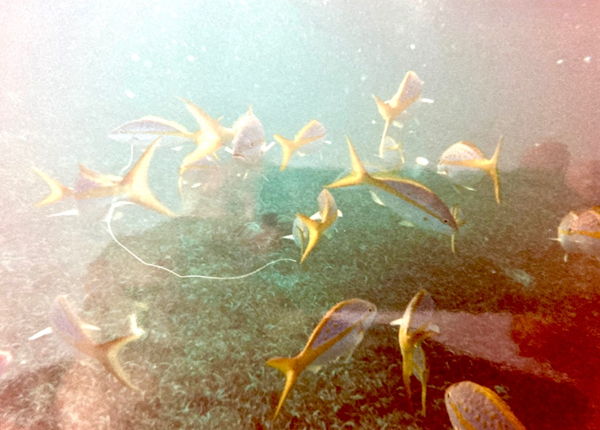
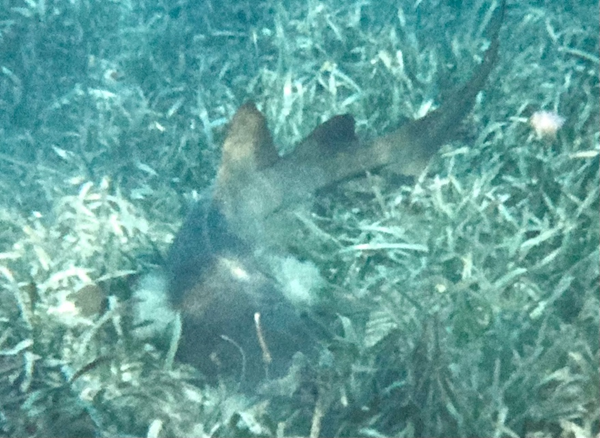
Left: A school of yellow-tailed snappers. Right: Nurse shark eating a conch.
Ideal snorkeling to me is floating in one spot and just observing the life below. Here, as the tide was going out, I had to keep paddling to overcome the mild but constant current. Not being a swimmer and without any flotation device, after an hour, I was somewhat apprehensive to find myself about 100 yards from the boat. I signaled to Marcel that I was going back to the boat to hang on to the anchor line and just observe without exertion.
When I got to the boat, there were no fish around. That seemed strange, since there were plenty when I left the boat. I raised my mask out of the water and said to Jane, “Throw a piece of that sandwich in the water so we can get some fish over here”. Then I put my mask back in the water. Just as I did that, I saw a movement in my peripheral vision. To my left was a large shark about 10 yards away! The shark was exactly at my level, just under the surface. It was significantly bigger than me, I estimated it to be 8 - 10 feet long.
The next 5 seconds are forever burnt into my memory. As soon as I spotted the shark, the sandwich hit the water. The shark instantly spun, reacting to the splash. I was directly between the shark and the sandwich! The shark exploded to top speed, heading straight towards me. I had one second of calm, thinking, “This shark is going to swim right past me, and I have a camera in my hand. I will get the best photo ever!”
But with one look directly into the shark’s eyes, total panic set in. I yanked on the anchor line I was holding and hauled myself up into the boat, yelling, “Shark!” to Jane. Of course, I still had my mouthpiece in so Jane could not decipher what I was saying. I landed face down in the boat right as Jane saw a large shark head emerge from the water, mouth open, right where my feet had just exited the sea. The shark head then quietly sank down into the depths.
No wonder there had been no fish around the boat earlier! Duh. I need to learn better how to “read the room.” It took me 5 minutes to calm down and gather myself. Looking into the water, the area around our boat was full of fish once again, so I went back in to continue snorkeling. A few minutes later Marcel and his cousin returned to the boat saying, “You missed it – we saw a large shark.” I assured them I had not.
We went from there back to the resort and bade a final goodbye to Marcel. Marcel was thrilled to have given us an adventure to remember. Back at the resort, Jane and I found a shark picture book. Without any discussion, we both independently identified my shark as a lemon shark – one of a few of the species with a record of human attacks!
The next day we began our journey home. A few weeks later, using Marcel’s business card, we e-mailed him to say how much we missed him and the local beer. Two weeks after that, a full case of Belikan beer showed up on our doorstep in Lynn, MA. How he arranged that we have no idea.
I’d love to know what happened to Marcel, whether he achieved his dream of owning a hunt club or if he's still surprising tourists with once-in-a-lifetime personal tours. We were so fortunate to find someone so totally fluent in the natural and social environment and willing to guide us through it. We will forever remember Marcel and the incredible experience he made possible for us in Belize!
Bill Boivin is a scientist, retired from 30 years of active duty with the United States Public Health Service. He is a Burlington Town Meeting Member and Conservation Commissioner. He and his wife, Jane, grew up in Lynn and now live in Burlington with their 2 mini dachshunds, 7 chickens, and Maya, a ball python. Bill and Jane have shared a love of nature, gardening, and wildlife for over 50 years. They have fostered, healed, raised, and loved a remarkable variety of animals in their time together. Learn more about Bill.