One Tough Old Tree: A Lesson for Us as We Age
A Burlington backyard maple has survived ice storms, lightning, and bacterial black ice. A 30-year friendship story about resilience and nature.

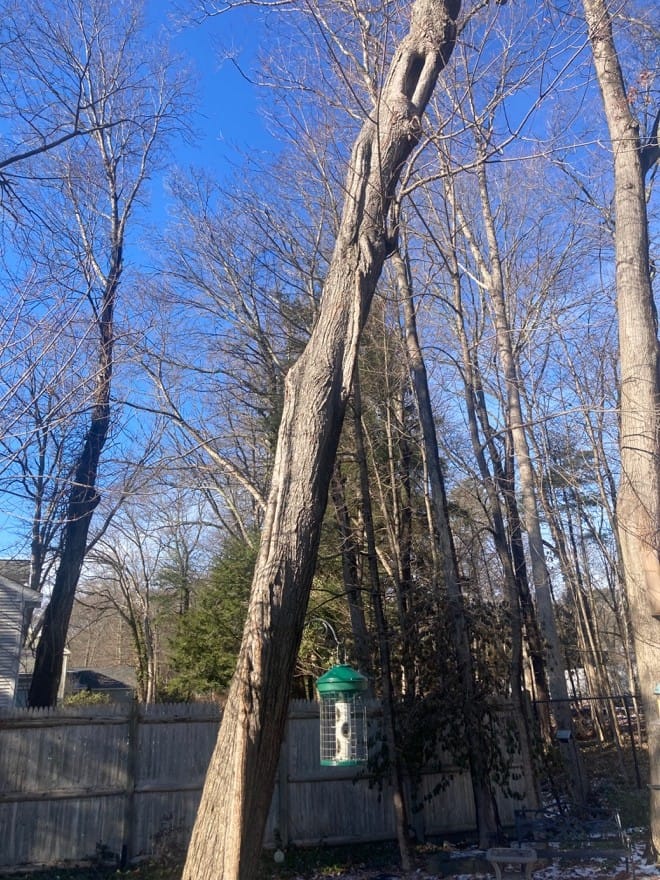
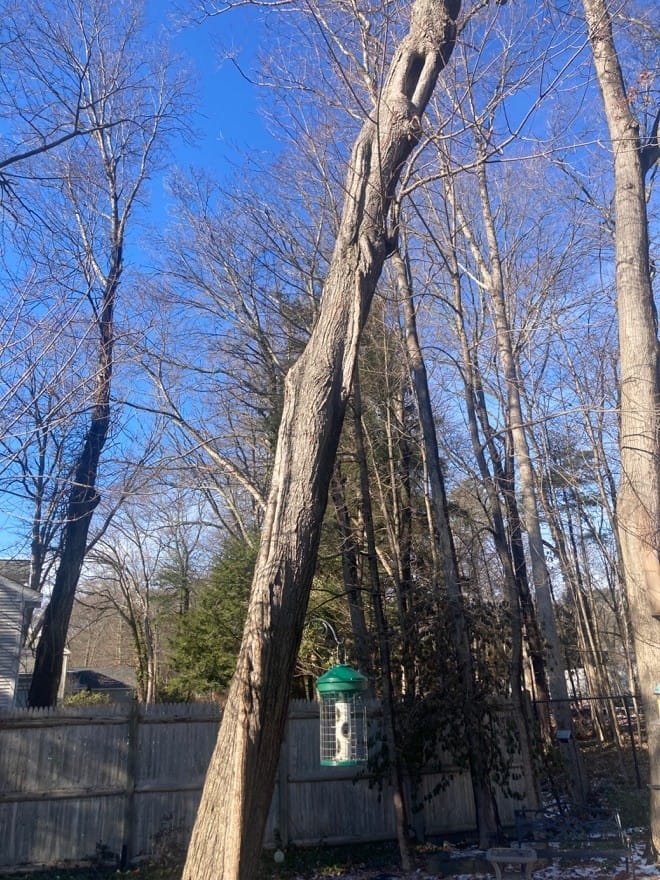
It can be hard to keep up with old friends. Unless, of course, they live right in your back yard. Red the red maple tree has been a friend of mine for over 30 years. At only 15 feet from our back door, Red is certainly a close friend – when measured by physical proximity, that is.
When my wife Jane and I moved into our house, the tree was healthy and, based on its diameter, likely already 50 or more years old – making both of us at least 75 today. Over our friendship, it has encountered multiple life-threatening events, yet it still clings to life and offers value to life around it.
In January 1998 there was a major ice storm over the eastern U.S. and Canada. Those of us who were around then remember the reports and photos of damage from up to four inches of ice during a multiple-day storm. Over 900 steel transmission towers and 24,000 power poles were toppled in Eastern Ontario and Southern Quebec. Much damage to power infrastructure and agriculture occurred in the U.S. as well, including damage to maple trees and apple trees.
Locally, Jane and I stood on our front porch after dark and listened to loud cracking noises coming from trees all around the neighborhood. In some cases, entire trees fell to the ground! It was impressive and terrifying at the same time.
Suddenly we heard a particularly loud crash just behind our house. Apprehensive about exposing ourselves to any falling tree branches, we rushed inside and looked out through the rear windows. A major limb halfway up that red maple had snapped clean off, striking the house just enough to strip the window screens off on its way down. Lucky for us, that was the extent of the damage to our home.
A decade later, that same tree was struck by lightning with house-shaking impact. A long, winding scar now highlights the track the lightning took as it traveled from treetop to ground.
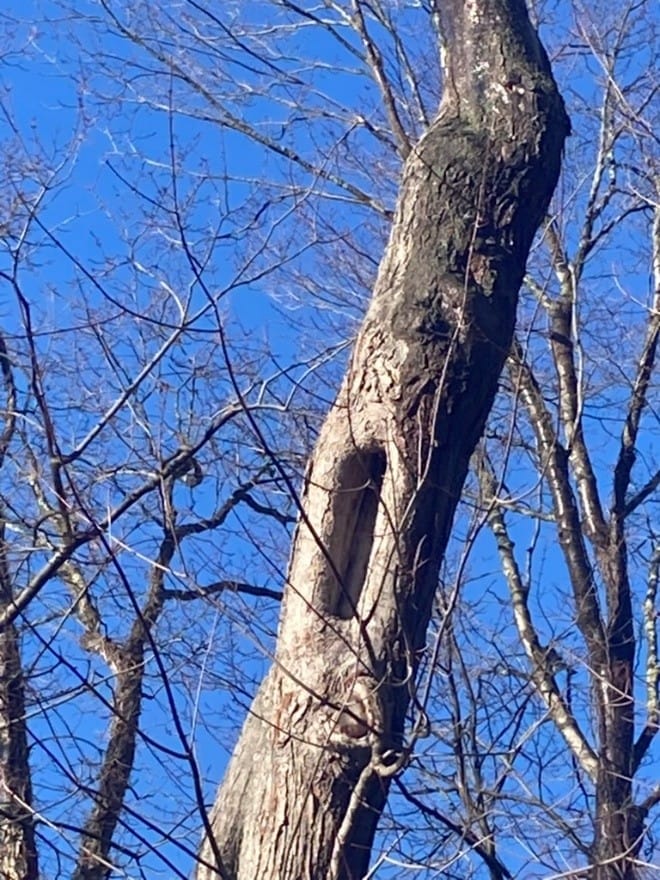
Wounded Left: The wound left when the major limb broke off. Note the healing ring around the injury. Right: The spiraling scar left behind by lightning nearly 20 years ago. Photos by Bill Boivin.
Some homeowners would have made the decision to cut down a tree with such a checkered history. But it leans away from the house, still appears stable, and provides substantial value to our yard. Of course, we decided to leave it standing.
In the shadow of that one tree, a significant shade garden grows: May apples, Virginia bluebells, ferns, Hosta, astilbe, ligularia, goat’s beard, Arisaema and azalea thrive there. It is near other trees whose roots are likely firmly interlaced with its own, “holding hands” and supporting each other. The hole that was left behind when the large limb broke off has been a home for flying squirrels, which have spent time in our yard nearly every night for over 20 years. The tree's trunk supports a hanging feeder of sunflower seeds – otherwise known as a revolving door of gray squirrels, red squirrels, flying squirrels (at night) and a myriad of birds. In the spring I watch as birds pick caterpillars off that tree to feed their young. The ecology of my yard would suffer greatly if the tree were removed.
After 30 years, you’d think Red had run out of ways to surprise us. But this winter, it showed us something entirely new. For years, the tree would occasionally show weeping along the lightning scar. This winter, I was intrigued to see a solidified black ooze following the spiral. I had never seen anything like it. A little research revealed that it was “bacterial wetwood” aka “slime flux.” A little lab work by a talented young friend showed it to likely be Bacillus megaterium (a gram-positive bacteria) and Pseudomonas syringae (a gram-negative bacteria). Both are common bacteria found in soil. Wet weeping wood provided a good medium for it to grow.
Just as sugar maples need cold nights and warm days to produce good sap flow, conditions here were just right to cause weeping in the day and freezing at night, leading to this remarkable cord of black ice!
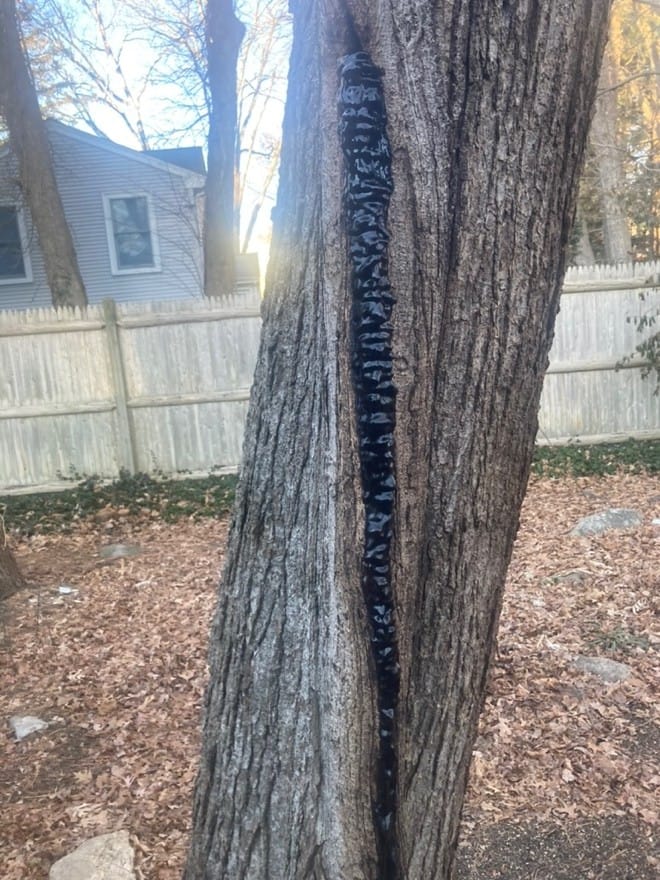
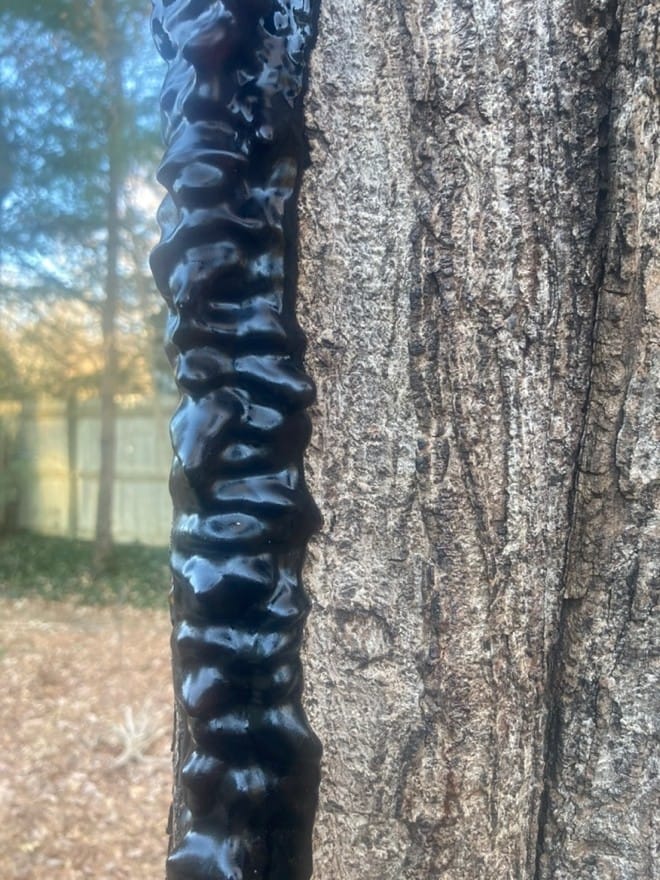
Black ice exactly followed the lightning scar. Photograph and close-up by Bill Boivin.
I admire and respect this tree as a remarkable example of endurance and resiliency. Red and I will grow older together and suffer life’s indignities, but I hope, side by side, we will continue to stand strong and offer value to our local community right up until the day we fall over…which, luckily for both of us, hasn’t happened yet!
Bill Boivin is a scientist, retired from 30 years of active duty with the United States Public Health Service. He is a Burlington Town Meeting Member and Conservation Commissioner. He and his wife, Jane, grew up in Lynn and now live in Burlington with their 2 mini dachshunds, 7 chickens, and Maya, a ball python. Bill and Jane have shared a love of nature, gardening, and wildlife for over 50 years. They have fostered, healed, raised, and loved a remarkable variety of animals in their time together. Learn more about Bill.