It’s the Unexpected That Makes a Vacation Memorable: An Unscripted Belize Adventure
A planned Belize group tour turns into an unforgettable private adventure—rain forests, Mayan ruins, shamans, and a guide who knew no limits.
Jane and I stood alone in a Belize City hotel lobby, looking around nervously. We had arrived promptly at 8:00 for our group tour, but no other group members had arrived. Had we misunderstood the day and time? Had they left without us?
We were not experienced travelers and had chosen Belize because it sounded exotic and featured the attractions we were interested in – beaches, rain forests, wildlife, and cultural sites – and also, because it had once been occupied by the British, English was its official language.
This was 1992, before widespread Internet and on-line purchasing, and so we’d booked the trip through a hole-in-the-wall travel agency, signing up for a group tour that included four days on the mainland and 4 days at a beach resort in Ambergris Caye (pronounced KEE). But where was the group?
That’s when Marcel walked into the lobby. “I’m here to lead the tour group,” he said. It turned out, Jane and I were the entire group! He looked us over and seemed to come to a decision. “Usually I tailor the pace of the tours to the slowest individuals,” he said, “and often there are seniors with canes. I’m willing to pick up the pace if you are. We can see a lot more than that itinerary.”
We replied with an enthusiastic “Yes!” Marcel seemed almost as excited as we were.
Marcel, native to Belize but educated in the US with a degree in marine biology, was working as a tour guide to save money with hopes of one day owning his own hunt club. We would soon learn that Marcel knew everything and everyone in Belize.
First thing, Marcel drove us to a bridge crossing a small river. It was maybe 200 yards long and wide enough for only one vehicle. Marcel started to drive across the river, just as another car entered from the other side. To our startled amazement, Marcel floored it, as did the guy coming the other way! Both cars went all the way to the middle of the bridge at top speed, braking abruptly just in time to avoid a collision.
Without any explanation, Marcel and the other driver both got out, walked to the front of their cars, and looked at the ground. The front wheels of the other car were just over a painted line that marked the midpoint of the bridge. Neither driver said a word. Marcel got back in our car and said, “He wins,” and backed all the way off the bridge.
That’s when we knew we were in for a fun four days with Marcel.
Our destination after lunch was a national park to see a cave and a waterfall. It was a lovely long drive through the rain forest to the cave. As Marcel was backing up to turn around and depart from the cave area, the passenger side wheels slid into a ditch. As much as he tried, he could not drive out. Marcel said he was going to walk to get help and would return. He was leaving us alone deep in the darkening forest, and his parting words as he walked out of sight provided cold comfort: “There’s a machete under the driver’s seat if you need it.”
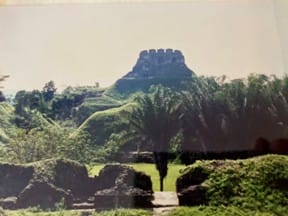
Jane and I decided the best course of action in the waning light was to use our flashlights and explore that cave, hoping to find bats. No such luck. So, we sat and waited in total darkness. After about two hours, we saw a vehicle approaching from the gloom. It was a jeep carrying three men… and Marcel! The men were able to tow us out of the ditch and drove away. The next day, Marcel wanted to show us Mayan ruins, but not the big touristy ones. He took us to two that were little known outside of the locals and were not fully excavated. To reach the first one we had to cross a river in a raft. It was Xunantunich (Zoo nahn too neech), The Woman of Stone. It was fascinating to see such ancient structures still mostly overgrown and buried in the ground.
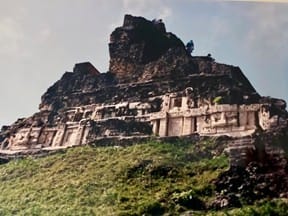
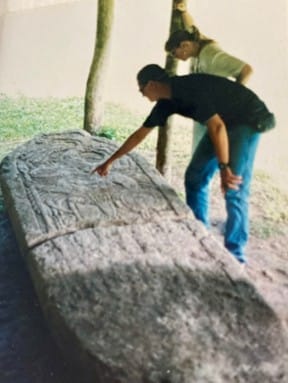
The ruins were intentionally unexcavated, as were several small hillocks. Marcel pointed out that each mound likely concealed another ruin. Belize had received several offers from foreign archaeologists to excavate, but the natives wanted to keep any such work in-house. Otherwise, foreigners would get all the glory of any findings, and once unearthed, it would be difficult to protect the sites from looters. The goal was to explore these sites at a pace achievable by indigenous Belizeans, with appropriate protections, even if it took decades. As I stood there, I tried to envision what this quiet ancient site must have looked like a thousand years ago, bustling with activity and hundreds of Mayans.
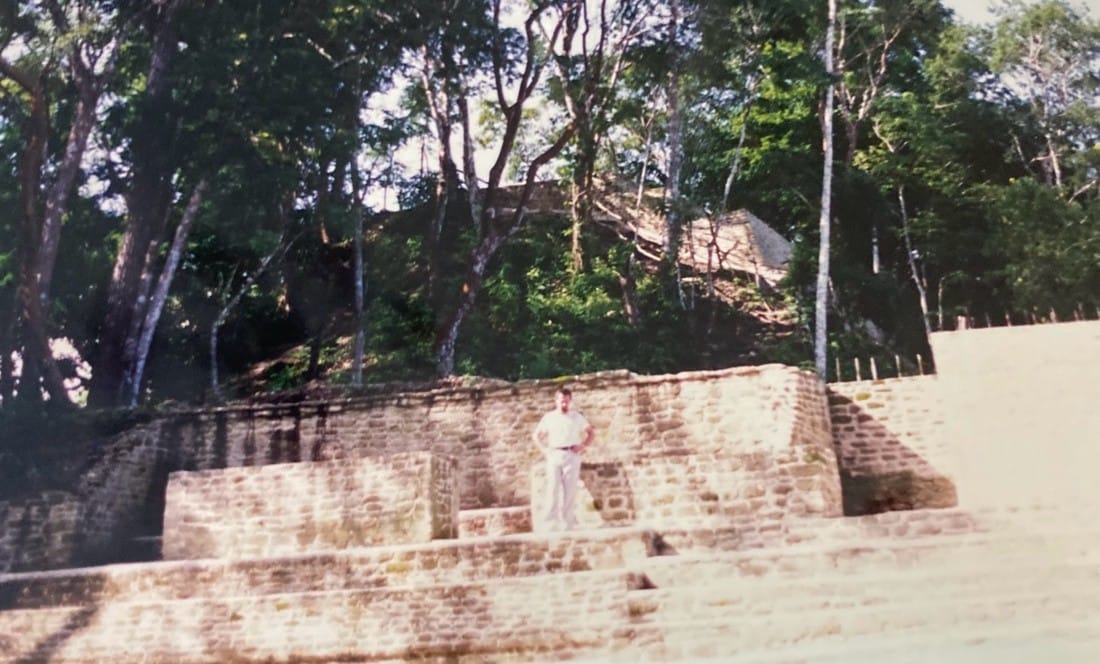
The second site we went to was surprisingly accessible, just down the street from a village. Named Cahal Peche, The Place of the Ticks, it was larger than Xunantunich. It was likely a royal structure, again not fully excavated. The highlight of this site was when Marcel pointed out the king’s throne, had me sit in it, and asked Jane to kneel in front of me and bow. That was the first and last time she ever did that, but I got it on film!

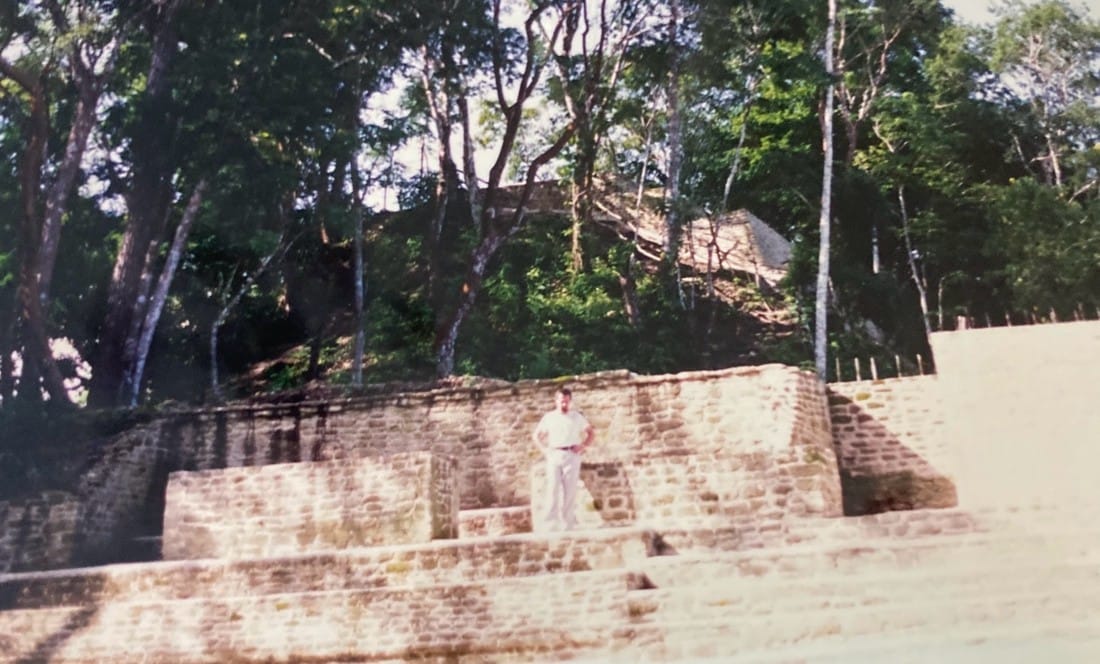
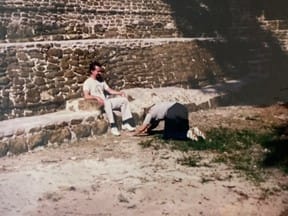
Cahal Peche - Place of the Ticks. And, a once-in-a-lifetime experience!
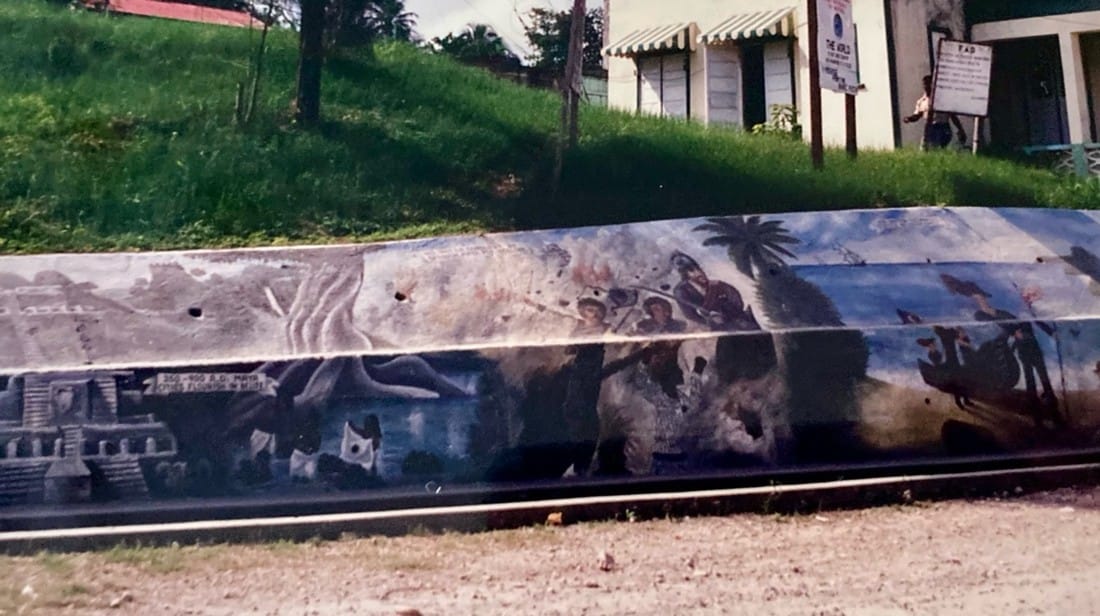
Driving through San Ignacio, Marcel drove us by a beautiful long mural by a local painter, Pedro Cruz. It showed the complete history of Belize, from the Mayans to present times. It was very impressive! My photo does not do it justice.
That evening we were taken to an open-air bar at the top of a tall hill, where the view was fabulous – as were the murals painted in that building. Most were scenes of ancient Mayan civilization, including images of sacrificing black panthers and other animals. We were not allowed to take any pictures. Those murals had also been painted by Pedro Cruz. After we had taken in the sights, Marcel introduced us to none other than Pedro Cruz!
It was a whirlwind four days with Marcel. He got a native to take us upriver in a dugout canoe to visit a local shaman. A tattered elderly gentleman who was headed in our direction hitched a ride with us in the canoe. We arrived at a small hut in the forest with an extensive garden. After a few minutes of walking around, the shaman came out to greet us. It was the old guy from the canoe! The shaman was very happy to show us around, pointing out several of the herbs and medicinal plants he grew or harvested from the forest. He pointed out one poisonous plant in the forest; growing next to it was its antidote plant. The shaman explained that this dichotomy often exists in nature. The energies of the toxic plant and its counterpart are linked, he said. (I see this in my own yard at home – poison ivy is surrounded by jewel weed, a natural treatment.)
In a spur-of-the-moment thing, Marcel one day said, “Want to go to Guatemala and try their Rooster beer?” Sure, why not. So, we drove to a border check point where we parked the vehicle. Marcel said that we would have to walk over the border – the village was just about a 30-minute walk away. We arrived in a small rural village with thatch roofs and chickens running around. After a lovely Rooster beer, we walked back to the Belize border. There were a few cars and pedestrians waiting to cross; papers were being examined in what looked like a very slow process. Marcel said “We don’t have to wait in this line. Give me your passports and $20 and I will talk us through.” We did as asked.
Marcel disappeared into the small checkpoint building. That’s when we realized what a vulnerable moment we had created. We held no passports; Marcel had disappeared, we did not speak the Guatemalan language, and we were being watched by several uniformed 16-year-olds with machine guns. After about five very nervous minutes, Marcel appeared on the Belize side of the border, waiving at us to come on over. We walked past vehicles and people in line, strolling right past the uniformed men checking papers, and back to Belize.
The last stop on our mainland tour was the Belize Zoo. After Belize became independent from Great Britain in 1981, people departing left behind tame native animals. One Brit stayed behind to care for the animals; starting a makeshift zoo which was eventually relocated, becoming a feature attraction. We stopped there on our way to the airport, but it was closed. Marcel paid no attention to that or to the rope lines around cages saying, “Do Not Go Beyond This Point.” We went right in and up to each enclosure. Marcel knew each animal by name, and they seemed to know him. He was scratching the puma behind the ears; he had Jane patting Alice the ocelot.
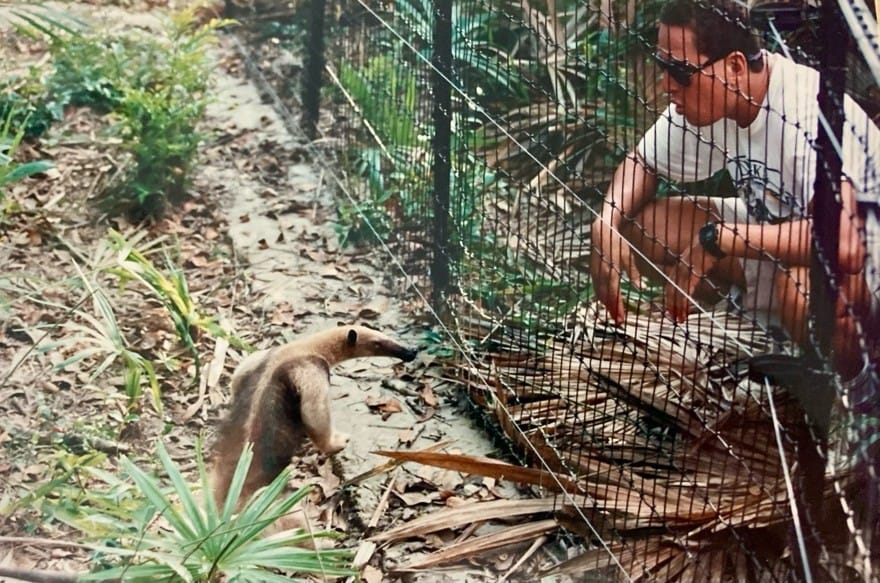
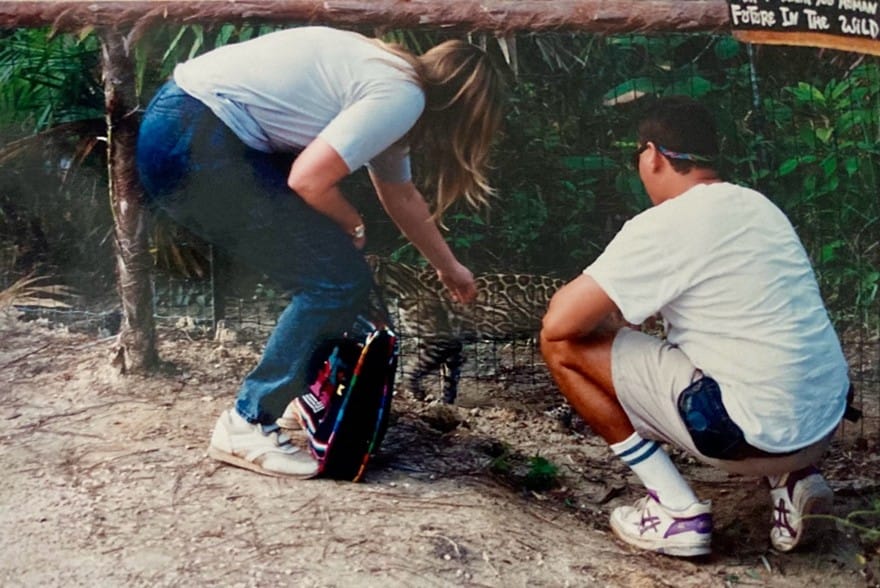
Left: Marcel with a friend. Right: Jane patting the ocelot, Alice.
Realizing we were 30 miles from the airport and had less than an hour to our flight time, we were getting nervous. “Don’t worry” said Marcel, “we will make it”. He was not the least bit concerned about the time. We got on the road, and he drove 90 miles per hour. (I was watching the speedometer). It was going to be very tight. Approaching the airport, Marcel ignored any passenger drop off signs, driving right out onto the runway and directly up to our small plane as they were beginning to raise the steps and close the door! We jumped out, handed our luggage to the luggage loader, and ran up the steps.
After four head-spinning days, we waved goodbye to Marcel and headed for Ambergris Caye for what was supposed to be four days of rest and relaxation. Little did we know it would include one of the most memorable days of our lives!
Bill Boivin is a scientist, retired from 30 years of active duty with the United States Public Health Service. He is a Burlington Town Meeting Member and Conservation Commissioner. He and his wife, Jane, grew up in Lynn and now live in Burlington with their 2 mini dachshunds, 7 chickens, and Maya, a ball python. Bill and Jane have shared a love of nature, gardening, and wildlife for over 50 years. They have fostered, healed, raised, and loved a remarkable variety of animals in their time together. Learn more about Bill.