
The Ants Go Marching
Army ants, antbirds, and a rain forest clearing crew: one Burlington resident's Panama expedition reveals nature's most perfectly interconnected system.

“Gather up your food and retreat to the trucks,” said Jim. “We’re leaving NOW!”
My wife Jane and I had been on an Earthwatch expedition in which Jim was the leader for over a week, spending our days capturing and tagging birds for his research study. By now we knew it was best to follow directions first and ask questions later.
This story was featured in our Spring Magazine
Read our Spring 2026 issue today — now arriving in Burlington mailboxes.
As we headed away, Jim explained: army ants had been seen entering our camp. Immediately, I understood his urgency.
Despite their tiny size, ants make up the largest animal biomass in the entire rain forest. We saw many different species over our 14 days at Pipeline Road in Panama, but the army ants were among the most mind-blowing. We’d witnessed them at work more than once. No right-minded human would want to stay in their path.
Army ants travel in two single-file lines – one coming, one going. One day, three of us followed one of these bidirectional highways to both ends.
At one end of the 100-yard procession, the ants had fanned out into a 50-foot-wide phalanx of marauders.

If you like being informed and connected to your community, sign up for the Daily Buzz newsletter now!
The site was pandemonium. Animals were fleeing, insects were running and flying for their lives, and birds were harvesting the frenzied insects. These “antbirds” are so named not because they eat the ants — they leave them alone — but because they feed on the chaos the ants create. Meanwhile, the ants scoured the land for anything that did not run away.
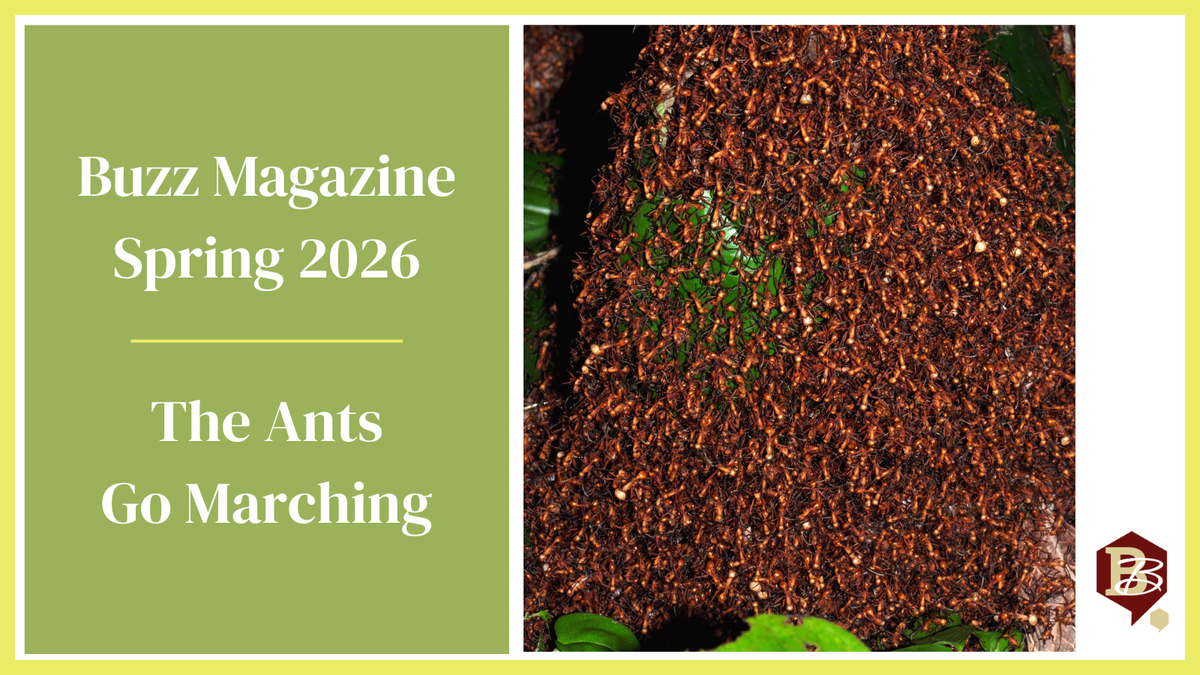
We then followed the line back to the “bivouac” at the other end of the line. This was their temporary, portable nest about the size and shape of a basketball. Inside were the other ants, eggs, and the queen. The outer wall of the nest consisted entirely of thousands of living ants locking legs together!
When good hunting was over at this site, the outer wall would dissolve and the entire army, eggs and all, would march off to set up camp in a new location.
Anticipating this would be the scene at our camp site, we took a four-hour excursion to Barro Colorado Island, a scientific research station for the Smithsonian Tropical Research Institute studying forest dynamics. When we returned, the ants were gone, and the whole site was spotless. Every crumb, insect, and animal was gone. It looked as if a cleaning crew had come in and swept the entire place, even inside our tents.
This is just one experience over our 14 days in Panama’s ancient, unspoiled tropical rain forest that helped me appreciate that the forest is not a collection of individual beings but is itself one living, breathing system made up of many dynamic, interconnected components. Our New England forests operate the same way — from ant colonies beneath fallen logs to spring peepers calling in vernal pools — each small part sustaining the whole and ensuring that life in the forest marches on.